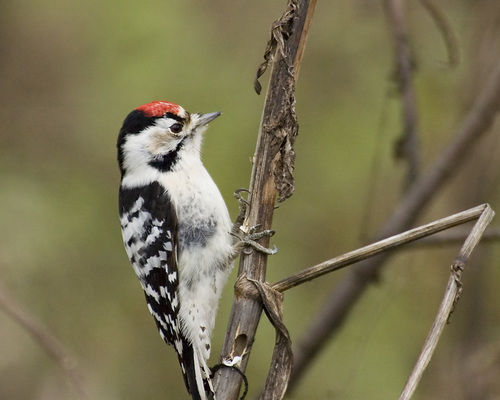
Lesser Spotted Woodpecker
Dryobates minor
The Lesser Spotted Woodpecker is a sparrow-sized master of the canopy, known for its rapid-fire drumming and striking 'ladder-back' plumage. Though elusive and small, this tiny acrobat is a crown jewel for any backyard wildlife enthusiast to capture on camera.
Quick Identification
Size
Length: 14–16 cm (5.5–6.3 in); Wingspan: 25–29 cm (9.8–11.4 in); Weight: 16–26 g (0.56–0.92 oz)
Colors
Black and white horizontal 'ladder' bars on wings/back; white underparts with light streaking. Males have a bright red crown; females have a plain white or buff crown.
Key Features
- Tiny sparrow-sized body
- Black and white barred 'ladder-back'
- No red on the undertail (vent) area
- Male has a red cap, female has a white/creamy cap
- High-pitched 'kee-kee-kee' call
When You’ll See Them
Geographic range
Where Does the Lesser Spotted Woodpecker Live?
The Lesser Spotted Woodpecker is widely distributed across the Palearctic region, stretching from the Atlantic coast of Europe and North Africa across Russia to Japan. In Europe, it is found in most countries from Scandinavia to the Mediterranean, though it is notably absent from Ireland and parts of Scotland. Its core populations are dense in the broadleaf forests of Central and Eastern Europe, where mature, decaying wood provides ample nesting and feeding opportunities.
Basemap © OpenStreetMap contributors
Behavior
The Lesser Spotted Woodpecker is the smallest and most elusive of the European woodpeckers. Unlike its larger cousins, it spends the vast majority of its time in the high canopy of mature trees, foraging on the outer tips of thin branches. Because of its size—roughly that of a house sparrow—and its preference for the treetops, it is much more often heard than seen. Its drumming is distinctive, being much longer and weaker than that of the Great Spotted Woodpecker, lasting over a second with a consistent tempo.
These birds are highly territorial and non-migratory, often remaining in the same patch of woodland for their entire lives. They are not particularly social and are usually seen alone or in breeding pairs. While they are shy around humans, they can be quite bold when defending their nesting cavities from competitors like tits or nuthatches. Their flight is deeply undulating, a characteristic trait of woodpeckers but appearing even more frantic due to their small size.
EverydayEarth exclusive
Camera Tips
Capturing a Lesser Spotted Woodpecker on a backyard camera is a master-level challenge because they rarely descend to the heights where most trail cams are mounted. To increase your chances, you must look up. If you have mature deciduous trees, mount your camera 10 to 15 feet high, angled slightly downward toward a fork in the branches or a known deadwood limb. This species is a canopy specialist, so ground-level setups will almost never capture them.
Standard bird feeders are rarely successful for attracting this species. Instead, try smearing suet or high-energy bird butter directly into the deep crevices of the bark on the upper branches of a tree. They prefer to forage on the vertical trunks of smaller limbs rather than perching on swaying feeders. Using a high-quality suet with insect meal can act as a powerful lure during the lean winter months when they are searching for easy calories.
Because these birds are small and move with quick, jerky motions, set your AI-powered camera to its highest trigger speed. If your camera supports 'Burst Mode,' enable it to capture 3-5 photos per trigger; this helps ensure at least one shot is clear as the bird drums or moves. High-resolution video is even better, as it allows you to capture their rapid-fire drumming, which is a key identifying feature.
Timing is everything. Early spring (late February to April) is the absolute peak window for sightings. During this time, trees are still mostly leafless, which improves your camera's line of sight, and the birds are at their most vocal and active as they establish territories. Positioning your camera near standing deadwood—especially decaying birch or alder—is highly effective, as these are their preferred sites for excavating nesting holes.
Similar Species
Species that look similar or are commonly confused with Lesser Spotted Woodpecker.
Great Spotted Woodpecker
Much larger (starling-sized) with large white shoulder patches and a bright red undertail.
Middle Spotted Woodpecker
Intermediate size with a red crown in both sexes and a pinkish wash on the vent, rather than the Lesser's pure white/streaked belly.
Downy Woodpecker
North American equivalent; similar size but has a solid white back stripe rather than the horizontal bars (ladder-back) of the Lesser Spotted.
Frequently Asked Questions
Record Lesser Spotted Woodpecker at your habitat
Connect a camera to start building your own species record — AI identifies every visitor automatically.