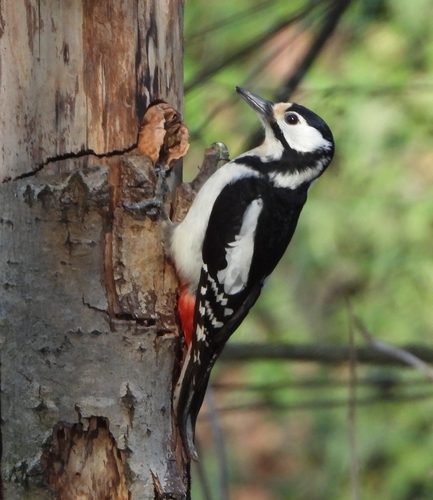
Great Spotted Woodpecker
Dendrocopos major
The percussionist of the forest, the Great Spotted Woodpecker is a master of tree-trunk acrobatics and rhythmic drumming. Easily recognized by its bold black-and-white patterns and crimson accents, it is one of the most rewarding species to spot in your own backyard.
Quick Identification
Size
Length: 20–24 cm (8–9.5 in), Wingspan: 34–39 cm (13.5–15.5 in), Weight: 70–98 g (2.5–3.5 oz)
Colors
Bold black and white plumage with a bright red lower belly. Males have a red patch on the nape; females have no red on the head. Juveniles feature a distinctive red crown.
Key Features
- Bold black-and-white 'pied' plumage
- Large white oval shoulder patches
- Bright crimson-red undertail area
- Powerful, chisel-like beak with stiff tail feathers for support
When You’ll See Them
Geographic range
Where Does the Great Spotted Woodpecker Live?
Native to the vast Palearctic region, the Great Spotted Woodpecker is the most widely distributed woodpecker across Europe and Northern Asia. Its core range extends from the British Isles and Scandinavia across the Russian taiga all the way to the Japanese archipelago, with southern populations reaching into parts of North Africa and the Mediterranean. In recent decades, this adaptable species has expanded its footprint, notably recolonizing Ireland and becoming a frequent sight in well-wooded suburban neighborhoods across the United Kingdom and Central Europe.
Basemap © OpenStreetMap contributors
Behavior
The Great Spotted Woodpecker is a charismatic and highly active bird known for its incredible arboreal acrobatics. It spends much of its day hitching itself up tree trunks in a vertical fashion, using its stiff tail feathers as a tripod for stability. It is perhaps most famous for its 'drumming'—a rapid-fire series of beak strikes against hollow wood used to mark territory and attract mates during the spring. This sound can carry for over a kilometer in dense forest.
These birds are remarkably resourceful foragers. They frequently use 'anvils'—specific crevices in tree bark where they wedge pine cones, nuts, or hard-shelled insects to hold them in place while they hammer them open. While generally solitary or found in pairs, they have become increasingly bold in suburban environments, often being the first species to dominate garden bird feeders, especially when suet or peanuts are available.
EverydayEarth exclusive
Camera Tips
To capture high-quality footage of a Great Spotted Woodpecker, position your camera 5 to 7 feet above the ground, aimed directly at a vertical trunk or a heavy-duty suet feeder. These birds prefer to land on the side of a tree and 'hitch' their way up or around to the food, so a side-on angle often yields better profile shots than a face-on view. If you are using a trail camera in the woods, look for 'anvils'—trees with piles of shredded pine cones at the base—as these are high-traffic areas where the bird will return daily to feed.
Because woodpeckers move with sudden, jerky motions and their drumming is lightning fast, set your camera to its highest possible frame rate (at least 60fps) and a fast trigger speed. Use a 'Photo + Video' mode if available; the photo will capture the crisp detail of the plumage, while the video will record the fascinating drumming or extraction behaviors. Short video clips of 10–15 seconds are ideal to conserve battery life while catching the action.
Baiting is highly effective for this species. High-energy suet blocks (especially those containing mealworms or insects) and whole peanuts in a mesh feeder are irresistible draws. During the winter months, placing a feeder in a location that receives good morning light will ensure your camera captures the vibrant red and white contrast against the darker winter wood. Ensure the camera is at least 3–4 feet away from the feeder to maintain focus, as these birds are larger than common garden tits.
Similar Species
Species that look similar or are commonly confused with Great Spotted Woodpecker.
Lesser Spotted Woodpecker
Much smaller (sparrow-sized) and lacks the large white shoulder patches and red belly of the Great Spotted.
Syrian Woodpecker
Very similar but lacks the black bar connecting the mustache to the nape, giving it a more 'open' white face.
Middle Spotted Woodpecker
Features a red crown in both sexes and lacks the black 'mustache' line connecting to the beak.
Frequently Asked Questions
Record Great Spotted Woodpecker at your habitat
Connect a camera to start building your own species record — AI identifies every visitor automatically.