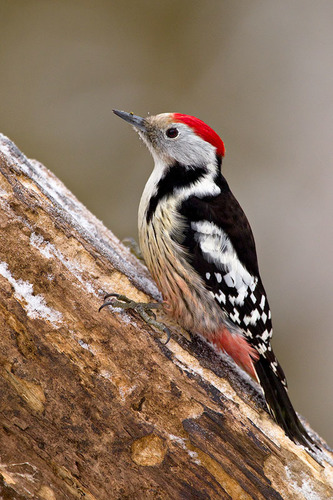
Middle Spotted Woodpecker
Dendrocoptes medius
Meet the specialist of the ancient oaks. The Middle Spotted Woodpecker is a vibrant, red-crowned beauty that trades the loud drumming of its cousins for a quiet life high in the canopy.
Quick Identification
Size
Length 20–22 cm (7.8–8.6 in); Wingspan 33–34 cm (13–13.4 in); Weight 50–85 g (1.8–3.0 oz)
Colors
White face and breast with yellowish wash; both sexes feature a bright red crown; flanks are heavily streaked with black; lower belly and vent are a soft rose-pink.
Key Features
- Bright red crown on both males and females
- Absence of the black 'moustache' stripe found in other woodpeckers
- Distinctive black streaking on pinkish-white flanks
- Smaller, more delicate bill compared to the Great Spotted Woodpecker
When You’ll See Them
Geographic range
Where Does the Middle Spotted Woodpecker Live?
The Middle Spotted Woodpecker is a resident of the Western Palearctic, with its core populations centered in Central and Eastern Europe. Its range extends from the Atlantic forests of northern Spain and France through Germany and Poland, reaching as far east as the Caucasus and parts of Iran. While it is well-established in the Balkan Peninsula, it is notably absent from the British Isles and most of Scandinavia, reflecting its strict requirement for temperate broadleaf habitats.
Basemap © OpenStreetMap contributors
Behavior
The Middle Spotted Woodpecker is a shy and specialized inhabitant of ancient deciduous woodlands. Unlike its more bold relatives, it spends most of its time high in the forest canopy, moving with surprising agility along slender branches and twigs. It is a 'gleaner' by nature, preferring to pick insects from the surface of the bark rather than hammering deep into the wood. This makes its presence much quieter and harder to detect than other woodpeckers.
While highly territorial, this species is less likely to drum on trees to signal its presence. Instead, it relies on a series of nasal, whining calls to establish its boundaries. In the winter, it may occasionally join foraging flocks of tits and nuthatches, but it remains largely solitary. Because of its reliance on mature trees, particularly oaks, it is often seen as an indicator species for the health of old-growth forest ecosystems.
EverydayEarth exclusive
Camera Tips
To capture the elusive Middle Spotted Woodpecker on an AI-powered camera, you must focus on height and tree texture. Since this bird rarely descends to the ground, mount your camera 6 to 10 feet (2-3 meters) high on the trunk of a mature, rough-barked tree—ideally an oak or a hornbeam. Positioning the camera to look along a large, horizontal limb can provide excellent 'action' shots of the bird gleaning insects from bark crevices.
While they are notoriously shy around standard bird feeders, you can entice them into your camera’s field of view by using 'stealth' baiting. Smear suet or high-energy peanut butter directly into the deep furrows of a tree's bark near your lens. This mimics their natural foraging behavior and makes them feel much safer than landing on a hanging plastic feeder. Ensure the bait is positioned where the morning sun can illuminate the bird, as this will help the AI accurately identify the subtle pink vent and red crown.
Timing is critical for this species. During the early spring (late February through April), Middle Spotted Woodpeckers become significantly more active as they establish territories and search for nesting cavities. Set your camera to a high-sensitivity trigger during these months. If your camera supports video, use short 10-15 second clips; this species moves quickly and erratically, and video is often the only way to distinguish it from the Great Spotted Woodpecker based on its lack of a 'moustache' and its dainty bill.
Similar Species
Species that look similar or are commonly confused with Middle Spotted Woodpecker.
Great Spotted Woodpecker
Larger with a black 'moustache' line; only males have a red nape patch, whereas both Middle Spotted sexes have red crowns.
Lesser Spotted Woodpecker
Much smaller (sparrow-sized) with a barred 'ladder' back and no red or pink coloration on the belly.
Syrian Woodpecker
Lacks the black bar connecting the moustache to the nape, but still possesses a moustache, unlike the Middle Spotted.
Frequently Asked Questions
Record Middle Spotted Woodpecker at your habitat
Connect a camera to start building your own species record — AI identifies every visitor automatically.