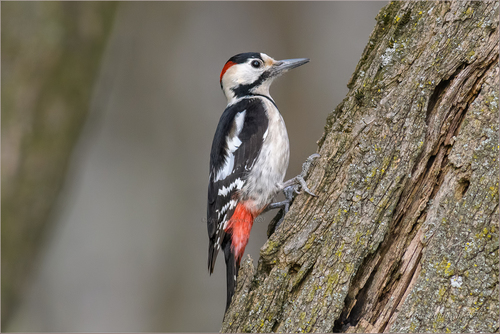
Syrian Woodpecker
Dendrocopos syriacus
The Syrian Woodpecker is a bold and industrious visitor to gardens and orchards across Europe and the Middle East. With its striking black-and-white pattern and clever use of 'smithies' to crack nuts, it is a fascinating subject for any backyard wildlife enthusiast.
Quick Identification
Size
Length 22-25 cm (8.7-9.8 in), wingspan 34-39 cm (13.5-15.5 in), weight 70-80 g (2.5-2.8 oz)
Colors
Bold black and white plumage; male has a red patch on the nape; both sexes have bright pinkish-red undertail coverts. Large white shoulder patches.
Key Features
- Unbroken white cheek patch extending to the neck without a black border
- Small red nape patch (males only)
- Prominent white shoulder patches on black wings
- Distinctive 'pinkish' red under the tail
When You’ll See Them
Geographic range
Where Does the Syrian Woodpecker Live?
The Syrian Woodpecker is native to the Middle East and Southeast Europe, having expanded its range significantly northward and westward over the last century. Its core populations are found across Turkey, Iran, Israel, and Greece, and it is now a common sight throughout the Balkans, Hungary, and Poland. As a highly adaptable species, it continues to colonize new urban and agricultural landscapes across Central Europe.
Basemap © OpenStreetMap contributors
Behavior
The Syrian Woodpecker is an exceptionally adaptable bird, known for its relative comfort around human habitation. Unlike many of its cousins that prefer deep forests, this species is a frequent visitor to suburban gardens, orchards, and urban parks. It is highly active during the day, spending much of its time hitching up tree trunks in a spiral fashion, probing for insects with its specialized tongue.
During the breeding season, which typically begins in early spring, these woodpeckers become quite vocal and territorial. They are famous for their rhythmic drumming on hollow wood, which serves as a long-distance communication tool. They are also known for creating 'woodpecker smithies'—crevices in bark where they wedge nuts or hard-shelled beetles to crack them open more efficiently with their powerful beaks.
EverydayEarth exclusive
Camera Tips
To capture high-quality footage of the Syrian Woodpecker, camera placement is critical. These birds are vertical climbers, so mount your AI camera on a mature tree trunk at eye level (approx. 1.5-2 meters). For the best results, point the camera at a limb that has rough bark or a known 'smithy'—a crevice where the bird might bring nuts to crack. Ensure the camera is positioned about 1 to 2 meters away from the target area to maintain focus and capture the fine details of their plumage.
Baiting is the most effective way to guarantee a visit. Syrian Woodpeckers are particularly fond of suet, unsalted peanuts, and halved walnuts. Using a suet cage or a specialized woodpecker feeder attached directly to a tree trunk will yield much better results than a hanging feeder. You can also smear peanut butter into the bark of a tree within the camera's field of view; this encourages the bird to stay in the frame longer as it works to extract the treat.
Timing and settings are key for these fast-moving birds. They are most active in the early morning hours just after sunrise. Set your camera to a high-sensitivity motion trigger and a short video clip length (10-15 seconds) to catch their rapid movements. If your camera allows for burst photography, use it; these birds move their heads incredibly fast while drumming or foraging, and a burst of photos increases the chance of getting a perfectly sharp, blur-free shot.
In the winter months, they are more likely to visit backyard setups as natural food sources become scarce. If you live in an area with fruit trees, placing a camera near ripening cherries or almonds in late summer can also capture unique foraging behavior. Always ensure the sun is behind the camera to avoid silhouetting the bird against the bright sky, which can wash out the subtle white markings on their face that distinguish them from similar species.
Similar Species
Species that look similar or are commonly confused with Syrian Woodpecker.
Frequently Asked Questions
Record Syrian Woodpecker at your habitat
Connect a camera to start building your own species record — AI identifies every visitor automatically.