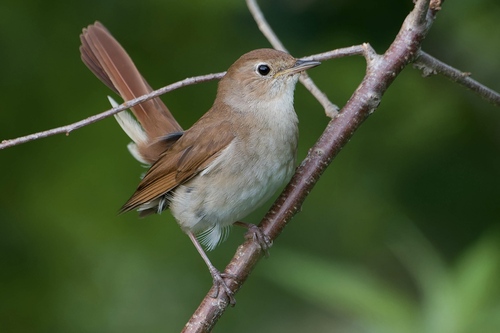
Common Nightingale
Luscinia megarhynchos
The Common Nightingale is the world's most celebrated songbird, possessing a vocal repertoire of over 1,000 unique sounds. Though it wears a humble brown coat, its presence transforms a backyard thicket into a nocturnal concert hall.
Quick Identification
Size
Length: 15–16.5 cm (5.9–6.5 in); Wingspan: 23–26 cm (9.1–10.2 in); Weight: 18–27 g (0.6–1.0 oz)
Colors
Uniform warm brown upperparts, buff-to-white underparts, and a distinctive rufous-brown tail and rump. Sexes are monomorphic (look identical).
Key Features
- Warm rufous-brown tail and rump
- Plain, unstreaked light brown plumage
- Large, dark liquid eyes with a faint pale eye-ring
- Highly secretive, ground-dwelling behavior
When You’ll See Them
Geographic range
Where Does the Common Nightingale Live?
This legendary songbird is native to the Palearctic, breeding across Western and Southern Europe, North Africa, and the Middle East into Central Asia. As a long-distance migrant, it travels south each autumn to spend the winter in the tropical belt of Sub-Saharan Africa. While its population is densest in Mediterranean climates, it remains a celebrated summer visitor to the damp thickets and woodlands of Northern Europe.
Basemap © OpenStreetMap contributors
Behavior
Common Nightingales are famously secretive and shy, preferring to remain deep within the shadows of dense thickets. While their song is incredibly bold and can be heard from over a mile away, the birds themselves are masters of concealment. They spend much of their time on the ground, moving with an upright, alert posture and flicking their tails as they hop through leaf litter in search of food.
Despite the name, Nightingales are active both day and night. During the breeding season, unmated males sing throughout the night to attract females migrating overhead, while mated males typically limit their singing to the dawn chorus. They are highly territorial and will vigorously defend their chosen patch of scrub, though they generally avoid direct interaction with humans and will stop singing if they sense a close approach.
EverydayEarth exclusive
Camera Tips
To successfully capture a Common Nightingale on an AI-powered camera, you must focus your efforts on the ground level. These birds are 'skulkers' and rarely venture into the open canopy. Position your camera just 6 to 12 inches above the ground, aimed at a small clearing within or directly adjacent to a dense thicket, bramble patch, or thick hedge. They are highly attracted to moist leaf litter, so placing the camera near an area where you have recently turned over soil or added mulch can provide excellent foraging shots.
While Nightingales are not typical visitors to elevated bird feeders, they are frequently drawn to ground-level water sources. A shallow, naturalistic birdbath placed near dense cover is your best bet for a clear 'hero' shot. Ensure the water is no more than an inch deep and that there are nearby branches for the bird to stage on before hopping down. This species feels most secure when cover is only a few inches away.
Given their nocturnal habits, it is essential to have a camera with high-quality infrared (IR) night vision. While they primarily sing from slightly higher perches at night, they will often descend to the ground at the very first hint of dawn. Set your camera's sensitivity to high during the twilight hours of 4 AM to 6 AM. In terms of seasonal timing, in Europe and the UK, ensure your cameras are active and monitored from mid-April when the first males arrive to establish territories.
Similar Species
Species that look similar or are commonly confused with Common Nightingale.
Thrush Nightingale
Duller, darker tail and a noticeably mottled or 'spotted' breast compared to the Common Nightingale's plain chest.
Dunnock
Features a grey head and breast with a thinner, needle-like bill, lacking the Nightingale's warm rufous tail.
Garden Warbler
Lacks any rufous tones in the plumage and has a much shorter, stouter bill and a more uniform olive-brown color.
Frequently Asked Questions
Record Common Nightingale at your habitat
Connect a camera to start building your own species record — AI identifies every visitor automatically.