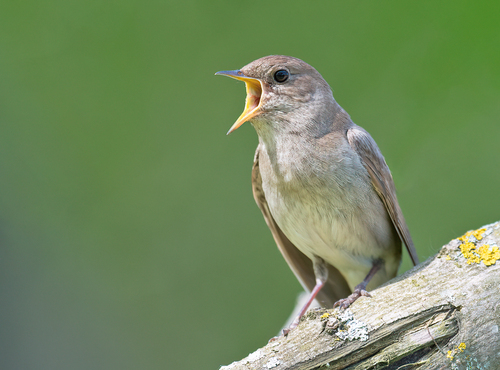
Thrush Nightingale
Luscinia luscinia
The Thrush Nightingale is the hidden virtuoso of the damp thicket, possessing a voice that can fill a forest and a plumage designed for perfect invisibility. To spot one is a rare reward for any backyard observer.
Quick Identification
Size
Length of 15–17 cm (6–6.7 in), wingspan of 24–26 cm (9.5–10.2 in), and weight between 18–30 g (0.6–1.1 oz).
Colors
Upperparts are a uniform olive-brown; the breast features a distinct 'cloudy' or mottled grayish-brown pattern over a pale throat and belly. Males and females are identical in appearance.
Key Features
- Distinct grayish-brown 'scaly' or mottled breast pattern
- Dull olive-brown upperparts without a bright rufous tail
- Large, dark 'doe' eyes in a plain face
- Short, thin bill adapted for picking up insects
When You’ll See Them
Behavior
The Thrush Nightingale is a master of camouflage and auditory brilliance. Known for its powerful, complex song that includes characteristic 'clicking' sounds, it is far more often heard than seen. It is a secretive 'skulker' that prefers to stay within the protection of dense, damp undergrowth, where it hops through leaf litter with a posture that is more horizontal than that of a robin.
Despite its shy nature, the Thrush Nightingale is a long-distance traveler, migrating from the damp forests of Eastern Europe and the Palearctic to spend its winters in tropical Africa. In a backyard setting, they are solitary and territorial during the breeding season, rarely tolerating other nightingales in their immediate vicinity. They interact with humans only indirectly, usually by serenading them from the depths of a thicket at dawn or dusk.
EverydayEarth exclusive
Camera Tips
To capture the elusive Thrush Nightingale on camera, you must focus on the 'dark zones' of your yard. Unlike many birds that visit hanging feeders, this species is almost exclusively terrestrial. Place your AI-powered camera 6 to 12 inches off the ground, pointing toward a patch of natural leaf litter or a damp, shaded corner of your garden. They are particularly attracted to the edges of dense shrubbery where they feel safe enough to emerge for a few seconds of foraging.
Water is your best lure. Because they are shy, they are less likely to use a pedestal birdbath and far more likely to visit a ground-level water feature. A shallow, rock-lined dish with a small dripper or solar-powered fountain will prove irresistible. Set your camera's trigger sensitivity to 'High,' as these birds move with quick, nervous hops and can disappear back into the brush in the blink of an eye. If your camera has a 'Pre-Roll' or 'Video' mode, use it to ensure you catch the bird as it enters the frame rather than just its tail as it leaves.
Timing is critical for this migratory visitor. In Northern and Eastern Europe, the best window is late May and early June when males are most active and vocal. Since they are crepuscular, ensure your camera has excellent low-light performance or infrared capabilities. Nightingales often forage in deep shade even during the day, so a camera with a high dynamic range (HDR) will help prevent the background from washing out while trying to capture the subtle, dark mottled patterns on their breast.
Similar Species
Species that look similar or are commonly confused with Thrush Nightingale.
Common Nightingale
The Common Nightingale has a much redder tail and a plain, un-mottled breast.
Song Thrush
Much larger than the Thrush Nightingale, with distinct heart-shaped spots rather than blurry mottling.
Garden Warbler
Smaller and rounder with a shorter bill, lacking any mottling on the breast.
Frequently Asked Questions
Record Thrush Nightingale at your habitat
Connect a camera to start building your own species record — AI identifies every visitor automatically.