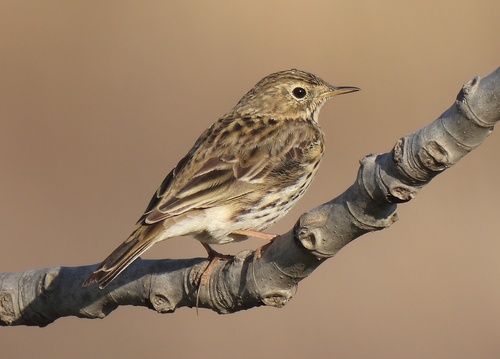
Meadow Pipit
Anthus pratensis
The Meadow Pipit is a master of the open fields, famous for its 'parachuting' song flight and its resilient nature. A true icon of the Palearctic wilderness, this streaked songbird brings life to the loneliest moors and coastal marshes.
Quick Identification
Size
Length: 14.5–15 cm (5.7–5.9 in); Wingspan: 22–25 cm (8.7–9.8 in); Weight: 15–25 g (0.5–0.9 oz)
Colors
Buff-brown upperparts with heavy blackish-brown streaking; creamy-white underparts with bold streaks on the breast and flanks; white outer tail feathers.
Key Features
- Fine, pointed bill typical of insectivores
- Extremely long, straight hind claw ('pipit claw')
- Distinctive 'parachuting' display flight
- Boldly streaked breast and flanks
- White outer tail feathers visible in flight
When You’ll See Them
Geographic range
Where Does the Meadow Pipit Live?
Native to the Palearctic region, the Meadow Pipit is a widespread sight across much of Europe and Northern Asia. Its core breeding range spans from the rugged coastlines of southeastern Greenland and Iceland through the British Isles and Scandinavia, extending as far east as the Ural Mountains in Russia. While many populations remain year-round residents in the milder climates of Western Europe, those in the north and east are migratory, journeying south to winter in the Mediterranean basin, North Africa, and parts of Southwest Asia.
Basemap © OpenStreetMap contributors
Behavior
The Meadow Pipit is a spirited ground-dweller, known for its preference for walking or running through short grass rather than hopping. During the breeding season, males perform a signature 'song flight' where they fly upward from the ground and then descend slowly on stiff wings, resembling a falling parachute while delivering a series of repetitive, tinkling notes. Outside of the nesting season, they are quite social, often forming loose, jerky-flying flocks that move through coastal areas and lowland fields in search of food.
These birds are notably wary but can become accustomed to human presence in areas with high foot traffic, such as public parklands or coastal paths. Interestingly, they are the most frequent host for the Common Cuckoo in many regions; the Cuckoo mimics the Meadow Pipit's eggs to trick them into raising a much larger, hungrier chick. In winter, their behavior shifts toward survival, with many birds migrating in small groups to warmer climates or moving toward the coast to avoid frozen ground.
EverydayEarth exclusive
Camera Tips
To capture the Meadow Pipit on camera, you must focus on ground-level placement. These birds are terrestrial foragers that spend the vast majority of their time navigating through grass and low vegetation. Position your camera on a stake or low-profile mount just 6 to 12 inches above the ground. This low angle provides an intimate view of their detailed plumage and captures their characteristic 'upright' alert posture that is often lost when looking down from a human height.
While Meadow Pipits rarely visit hanging bird feeders, they are highly attracted to open water and mud. Placing your camera near a shallow, ground-level birdbath or a natural puddle at the edge of a field can produce excellent results, as they frequently visit these spots to drink and bathe. If you are setting up in a backyard or garden during the winter months, scattering a handful of live mealworms or small suet crumbs on a patch of short-mown grass can act as an irresistible lure for these insect-loving birds.
Lighting and camera settings are crucial because their streaked brown feathers provide excellent camouflage against dry grass. Try to position your camera facing north or south to avoid direct glare, and ensure the lens has a clear line of sight through the grass blades to prevent the autofocus from jumping to the foreground. Using a high-speed trigger or a burst photo mode is highly recommended, as Meadow Pipits move with quick, jerky motions and often flick their tails, which can be a challenge for slower cameras to capture sharply.
Similar Species
Species that look similar or are commonly confused with Meadow Pipit.
Frequently Asked Questions
Record Meadow Pipit at your habitat
Connect a camera to start building your own species record — AI identifies every visitor automatically.