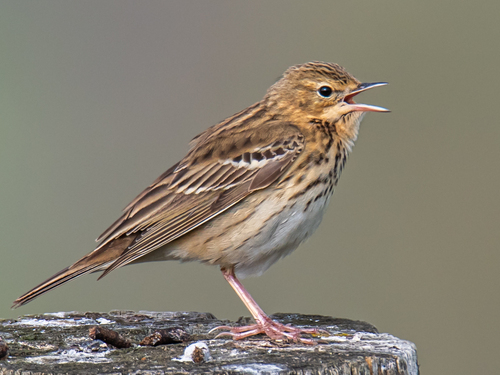
Tree Pipit
Anthus trivialis
A master of the woodland edge, the Tree Pipit is famous for its spectacular 'parachute' song flight. This elegant traveler brings a touch of wild melody to open clearings every spring.
Quick Identification
Size
14-16 cm (5.5-6.3 in) long; wingspan of 25-27 cm (9.8-10.6 in); weight 18-25 g (0.6-0.9 oz)
Colors
Brownish-grey upperparts with dark streaks; buff-colored breast with bold black streaking; white belly; pinkish-brown legs
Key Features
- Boldly streaked buff breast contrasting with a cleaner white belly
- Heavier, more curved bill than the Meadow Pipit
- Short, curved hind-claw adapted for perching in trees
- Distinctive 'parachute' descent during song flight
When You’ll See Them
Behavior
Unlike many other pipits that remain strictly on the ground, this species is semi-arboreal, frequently using high branches as lookout posts and singing stations. On the ground, they walk with a graceful, rhythmic gait rather than hopping, often pumping their tails up and down as they forage through the leaf litter or low grass. While they are migratory and solitary for much of the year, they are highly territorial during the summer months, making their presence known with their loud, piercing calls.
EverydayEarth exclusive
Camera Tips
To capture the Tree Pipit on camera, you must understand their preference for 'edge' habitats. These birds rarely venture into deep, dark forests or wide-open, treeless fields. Position your camera at the transition zone where a wooded area meets a meadow or garden. Because they spend significant time foraging on the ground, a low camera placement (about 6 to 12 inches off the ground) is ideal. Aim the lens at patches of bare earth or short grass near the base of a prominent tree, as they often hop down from their perches to snatch up insects in these spots.
One of the best ways to guarantee a sighting is to identify a 'song post.' Tree Pipits are creatures of habit and will return to the same high branch or fence post dozens of times a day to sing. If you can safely mount a camera on a nearby trunk or a high tripod facing one of these perches, you will likely capture stunning, eye-level footage. Use a high shutter speed or 60fps video setting to account for their sudden, jerky movements and the rapid fluttering of their song flights.
Unlike backyard finches, Tree Pipits won't be drawn in by birdseed or suet. Instead, focus on water. A shallow ground-level birdbath or a small pond with a sloping edge is an irresistible draw for a bird that spends its day singing in the hot sun. If you have an AI-powered camera, set the motion sensitivity to 'High,' as their slender frames and quick walking pace can sometimes fail to trigger less sensitive sensors. During their spring arrival in April, a fresh water source is the single most effective lure you can provide.
Similar Species
Species that look similar or are commonly confused with Tree Pipit.
Meadow Pipit
Found in more open grasslands; has a longer, straighter hind claw and lacks the Tree Pipit's habit of perching high in trees.
Rock Pipit
Larger and darker with smudgier markings; strictly tied to coastal rocky shores rather than inland woodlands.
Olive-backed Pipit
A rare visitor with a greener back and a much more distinct white 'supercilium' (eyebrow) and ear spot.
Frequently Asked Questions
Record Tree Pipit at your habitat
Connect a camera to start building your own species record — AI identifies every visitor automatically.