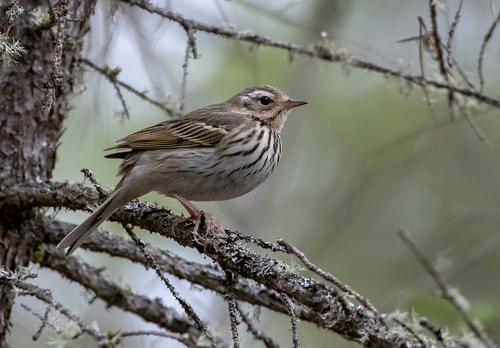
Olive-backed Pipit
Anthus hodgsoni
A woodland-loving traveler with a rhythmic tail-wag, the Olive-backed Pipit is a master of camouflage in the forest shadows. Look for its striking white 'eyebrow' and olive-toned plumage as it scurries through your garden's leaf litter.
Quick Identification
Size
14.5–16 cm (5.7–6.3 in) long; 24–27 cm (9.4–10.6 in) wingspan; 18–25 g (0.6–0.9 oz) weight
Colors
Olive-green or olive-brown upperparts with faint streaks; cream to white underparts with bold black streaks on the breast and flanks; distinctive white eyebrow (supercilium) and a small white spot on the ear coverts.
Key Features
- Distinctive olive-green wash on the back
- Bold white supercilium above a dark eye-line
- Constant rhythmic downward tail-pumping
- Small white spot at the back of the ear coverts
When You’ll See Them
Behavior
The Olive-backed Pipit is a distinctive member of the pipit family, notable for its preference for wooded areas rather than the open grasslands favored by its cousins. While it spends much of its time foraging on the ground with a characteristic deliberate walk, it is famous for its 'tree-pipit' behavior—when startled, it will fly up into the safety of the branches rather than staying on the ground or flying into the open.
You will often notice this bird due to its constant movement. As it walks, its tail pumps up and down rhythmically, a common trait among pipits and wagtails. During the wintering season, they are somewhat social and can be found in small, loose groups, often blending into the leaf litter of forest floors or suburban parks. They are relatively quiet while feeding, but they possess a thin, high-pitched 'tzit' call that often reveals their presence before they are seen.
EverydayEarth exclusive
Camera Tips
To successfully capture an Olive-backed Pipit on your backyard camera, placement is everything. These birds are ground-feeders that thrive in 'edge' habitats. Position your camera at ground level, or no more than 6 inches high, pointing toward a patch of dappled shade or a leaf-covered area under the canopy of a tree. They feel safest when they have overhead cover nearby, so avoid placing cameras in the middle of a wide, open lawn. Instead, aim for the transitional zone where the lawn meets a flower bed or a wooded perimeter.
A major secret to attracting Olive-backed Pipits is water. While they may ignore traditional bird feeders, they are highly attracted to shallow, ground-level water features. A 'dripper' or a small recirculating fountain over a shallow stone basin is an irresistible lure. Set your camera to focus on the edge of the water where the birds are likely to land and scan for predators before drinking. Because they move their tails and heads rapidly, use a high shutter speed or a high-frame-rate video setting (at least 60fps) to ensure the images aren't blurred by their constant motion.
Timing is critical for this species. In their wintering range, they are most active in the cool of the early morning. If your AI camera has a 'Burst Mode,' enable it; these birds often make quick, jerky movements and having a sequence of 3-5 photos will help you get that one perfect shot where their distinctive white ear spot and olive back are clearly visible. If you are trying to capture them during migration, monitor local birding reports for 'fallouts' after rainy weather, which is when they are most likely to drop into suburban gardens to rest and refuel.
Similar Species
Species that look similar or are commonly confused with Olive-backed Pipit.
Tree Pipit
The Tree Pipit has a browner, more heavily streaked back and lacks the prominent white spot on the ear coverts.
Meadow Pipit
Meadow Pipits prefer open fields over wooded areas and have longer hind claws and less distinct head markings.
Forest Wagtail
Similar habitat and tail-wagging, but the Forest Wagtail has bold horizontal wing bars and a distinct chest band.
Frequently Asked Questions
Record Olive-backed Pipit at your habitat
Connect a camera to start building your own species record — AI identifies every visitor automatically.