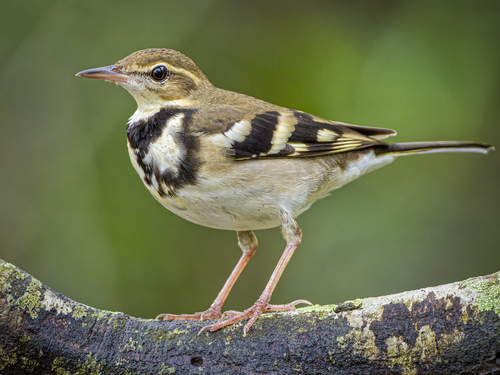
Forest Wagtail
Dendronanthus indicus
Meet the rebel of the wagtail family—the only one that wags its tail sideways and nests high in the trees. A master of the shaded forest floor, the Forest Wagtail is a seasonal gem for backyard observers across Asia.
Quick Identification
Size
Length 16.5–18 cm (6.5–7 in); weight 14–17 g (0.5–0.6 oz); wingspan approx 25–28 cm (10–11 in)
Colors
Olive-brown or greenish-grey upperparts, creamy white underparts with two distinct black breast-bands (the upper one is a complete 'V' shape, the lower one is often broken). White wing bars are prominent.
Key Features
- Distinctive sideways tail-wagging motion
- Two bold black breast-bands across a white chest
- Only wagtail species that builds nests in trees
- Olive-brown back with prominent white wing bars
When You’ll See Them
Geographic range
Where Does the Forest Wagtail Live?
The Forest Wagtail is a wide-ranging traveler of the Asian continent. It breeds in the temperate forests of East Asia, spanning from eastern Siberia and northern China through to the Korean Peninsula and parts of Japan. When winter arrives, these birds migrate south to the tropical regions of South and Southeast Asia, where they can be found in abundance across India, Sri Lanka, Thailand, Malaysia, and the Indonesian islands. This makes them a seasonal highlight for birdwatchers across a vast geographic stretch of the Orient.
Basemap © OpenStreetMap contributors
Behavior
The Forest Wagtail is a fascinating outlier in the wagtail family. While most wagtails are known for their frantic up-and-down tail pumping, this species wags its tail and the entire rear of its body in a rhythmic, sideways 'pendulum' motion. This unique behavior makes them instantly recognizable even from a distance or on low-resolution camera footage.
Unlike many of its cousins that prefer wide-open spaces and riverbanks, the Forest Wagtail is a creature of the shadows. It is relatively shy and prefers the dappled light of forest floors, wooded gardens, and shaded plantations. They are primarily solitary foragers, walking slowly and deliberately across the ground to pick insects from the leaf litter rather than chasing them in flight.
One of their most remarkable traits is their nesting habit. While other wagtails are ground-nesters that tuck their eggs into crevices or grass, the Forest Wagtail builds a neat cup-shaped nest high up in the horizontal fork of a tree limb, usually camouflaged with moss and cobwebs.
EverydayEarth exclusive
Camera Tips
To successfully capture a Forest Wagtail on your backyard camera, you need to think like a forest dweller. These birds avoid bright, open lawns. Instead, position your camera in the most shaded, 'wild' corner of your garden, particularly where there is a thick layer of natural mulch or fallen leaves. They are highly attracted to damp areas, so placing your camera near a low-profile birdbath or a leaking garden tap can yield excellent results.
Camera placement is critical for this species. Since they are ground foragers, mount your camera very low—ideally between 6 and 10 inches off the ground. Angle the lens slightly upward to capture their full profile as they walk past. Because their primary identification feature is their movement, we highly recommend using Video Mode or a high-speed Burst Mode. A still photo might miss the sideways swaying that distinguishes them from other wagtails.
Standard bird feeders won't work for this insect-eater. However, you can 'bait' an area by keeping a patch of soil moist or by adding a shallow tray of mealworms near a pile of logs. They are most active in the soft light of the early morning. Ensure your camera's PIR sensor sensitivity is set to 'High' to detect their relatively small body size, and if your camera allows, adjust the exposure to compensate for the deep shadows they prefer to inhabit.
Similar Species
Species that look similar or are commonly confused with Forest Wagtail.
Frequently Asked Questions
Record Forest Wagtail at your habitat
Connect a camera to start building your own species record — AI identifies every visitor automatically.