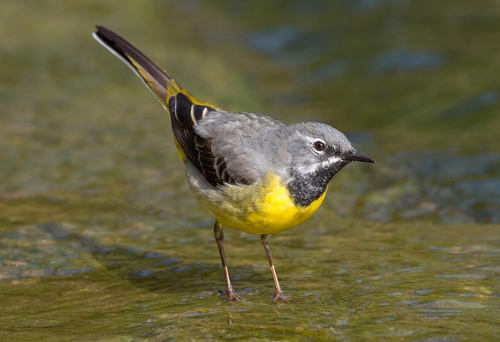
Grey Wagtail
Motacilla cinerea
Elegant, energetic, and strikingly yellow, the Grey Wagtail is the prima ballerina of the riverbank. Watch for its signature tail-bob as it hunts insects along garden ponds and streams.
Quick Identification
Size
18–19 cm (7–7.5 in) in length; 25–30 cm (10–12 in) wingspan; 14–22 g (0.5–0.8 oz)
Colors
Slate grey upperparts with bright yellow underparts (especially the vent). Breeding males have a distinctive black throat patch.
Key Features
- Extraordinarily long, bobbing tail
- Slate-grey back and wings
- Bright lemon-yellow under-tail coverts and belly
- Sharp, high-pitched 'tsit-tsit' call
When You’ll See Them
Geographic range
Where Does the Grey Wagtail Live?
Native to a vast territory spanning Eurosiberia, the Grey Wagtail is found from the British Isles across Europe and Central Asia to Japan. While populations in Western Europe are often year-round residents, those breeding in colder northern and eastern regions are highly migratory, wintering in tropical Africa, the Indian subcontinent, and Southeast Asia. They are increasingly common in suburban areas where garden ponds and artificial water features provide a suitable substitute for their natural mountain stream habitats.
Basemap © OpenStreetMap contributors
Behavior
The Grey Wagtail is a bird of constant motion, defined by the rhythmic up-and-down pumping of its exceptionally long tail. Unlike many other garden birds, it is a specialist of moving water, spending much of its time flitting between slippery rocks and mossy banks. Its flight is characterized by deep, bounding undulations, often accompanied by a sharp, metallic call that alerts observers to its presence long before it lands.
These birds are highly territorial during the breeding season and are typically seen alone or in pairs. They are incredibly agile hunters, often performing short, flycatcher-like aerial sallies to snag midges and flies mid-air. While they are naturally wary, they have adapted well to human environments, frequently nesting in the crevices of stone bridges, old walls, or even specialized nest boxes placed near fast-flowing garden streams.
EverydayEarth exclusive
Camera Tips
To capture high-quality footage of a Grey Wagtail, the most critical factor is proximity to water. If your property has a stream, waterfall, or even a decorative garden pond with a rocky edge, place your camera there. Position the lens just 6 to 10 inches above the ground, angled toward a 'landing stone'—a flat rock that sits slightly out of the water. These birds use these stones as observation decks to scout for insects, providing the perfect stage for a clear shot.
Because the Grey Wagtail is famous for its rapid tail-flicking and quick movements, camera settings are paramount. Use a high-speed trigger setting or a high-frame-rate video mode (60fps or higher) to avoid motion blur. If your camera allows for sensitivity adjustments, set it to high, as these birds are small and move with sudden, jerky motions that might fail to trigger slower sensors. Diurnal placement is essential; they are strictly active during daylight, with a peak in activity during the early morning hours when insect hatches occur near the water surface.
While they don't frequent standard seed feeders, you can 'bait' an area to encourage them to stay longer in your camera's field of view. Try placing live mealworms in a shallow, rimmed dish hidden behind a rock near the water's edge. This mimics their natural foraging behavior and will keep them stationary for several seconds—a rare treat for this normally restless species. In winter, they become less picky and may be attracted to suet crumbs scattered on a flat stone if the ground is frozen.
Similar Species
Species that look similar or are commonly confused with Grey Wagtail.
Frequently Asked Questions
Record Grey Wagtail at your habitat
Connect a camera to start building your own species record — AI identifies every visitor automatically.