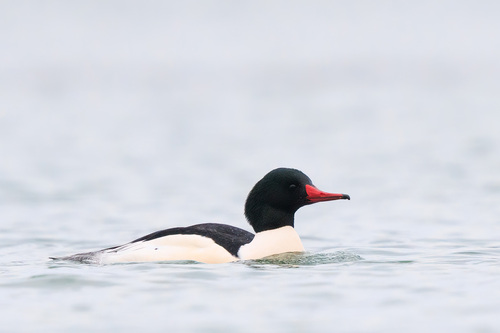
Common Merganser
Mergus merganser
Streamlined and elegant, the Common Merganser is a master of the waterway, known for its striking white plumage and uncanny ability to disappear beneath the surface in search of fish. Whether they are gliding through a mountain lake or nesting high in a forest tree, these 'sawbills' are a rewarding sight for any backyard observer.
Quick Identification
Size
Length 23-28 in (58-72 cm); Wingspan 31-38 in (78-97 cm); Weight 2-4.6 lbs (0.9-2.1 kg)
Colors
Males have a dark green head (appearing black), bright white body, and black back; females are gray with a cinnamon-brown head and white throat. Both have thin, serrated red bills.
Key Features
- Long, serrated red 'sawbill'
- Clean white body with dark green-black head (males)
- Shaggy cinnamon-brown crest (females)
- Direct, fast flight low over water
When You’ll See Them
Geographic range
Where Does the Common Merganser Live?
Native to the Northern Hemisphere, the Common Merganser occupies a vast territory stretching across North America, Europe, and Asia. In the United States and Canada, they are a staple of freshwater systems, breeding in the boreal forests and wintering as far south as Mexico. In Eurasia, where they are often called Goosanders, their range extends from the British Isles and Scandinavia through Russia to the Pacific coast of China and Japan, making them one of the most widespread waterfowl species in the world.
Basemap © OpenStreetMap contributors
Behavior
The Common Merganser is a masterful aquatic predator, spending much of its time diving in pursuit of fish. Unlike dabbling ducks that tip up to eat vegetation, this species uses its streamlined body and powerful webbed feet to navigate underwater with surprising speed. They are social birds, often seen in small groups or 'rafts,' though they become more solitary or pair-based during the nesting season. When startled, they take off from the water with a long, pattering run across the surface before gaining flight.
Unique among many waterfowl, these ducks are cavity nesters, often choosing holes in large, old-growth trees up to 100 feet off the ground. This brings them into unique interactions with forested landscapes. While they are generally wary of humans, they have adapted well to suburban lakes and reservoirs, provided the water remains clear enough for them to hunt by sight. Their presence is often considered an indicator of a healthy, productive aquatic ecosystem.
EverydayEarth exclusive
Camera Tips
To capture the Common Merganser on a trail camera, focus your efforts on the water's edge rather than deep woods. These ducks are most active near shorelines where they take breaks to rest or preen. Look for 'loafing logs'—partially submerged logs or rocks that stick out of the water. Mount your camera on a nearby tree or a sturdy stake about 12 to 18 inches above the log's surface, angling it slightly downward to capture the bird's full profile as it climbs out of the water.
Since Mergansers are visual hunters that eat live fish, traditional birdseed or suet won't attract them. Instead, focus on their natural nesting behavior. If you live near a wooded river or lake, installing a large wood duck box (with an appropriately sized 5-inch hole) can bring them right to your property during the spring. Place your camera on an adjacent tree facing the box entrance from a distance of 10-15 feet to witness their acrobatic arrivals and departures.
Lighting is crucial for this species due to the male's high-contrast white feathers. To avoid 'white-out' images where detail is lost, position your camera facing north or south to prevent direct sun glare on the water or the bird's plumage. Set your camera to a high shutter speed or 'burst mode' if available, as these birds are incredibly fast and can vanish under the water in a split second. Early morning (6:00 AM to 9:00 AM) provides the best activity and softest light for stunning captures.
For technical settings, prioritize a fast trigger speed. Mergansers are skittish; by the time they've landed or dove, a slow camera might only capture a splash or a tail feather. If your camera allows for video, 15-second clips are ideal for capturing their fascinating preening and 'wing-stretching' behaviors on loafing logs. Because these birds inhabit damp environments, ensure your camera housing is well-sealed and consider using a desiccant pack inside the case to prevent lens fogging during humid mornings.
Similar Species
Species that look similar or are commonly confused with Common Merganser.
Hooded Merganser
Much smaller with a fan-like crest; males have a large white patch on their black head, while females have a wispy, mohawk-like crest.
Red-breasted Merganser
Males have a shaggy double-crest and a reddish chest; females have a blurry, blended transition between their brown head and gray neck.
Frequently Asked Questions
Record Common Merganser at your habitat
Connect a camera to start building your own species record — AI identifies every visitor automatically.