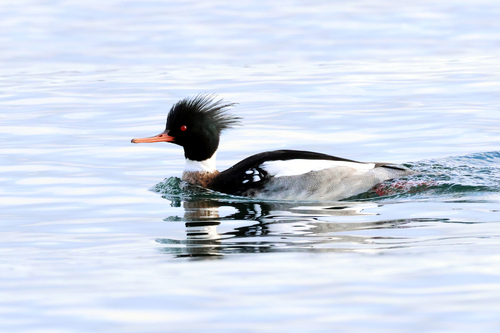
Red-breasted Merganser
Mergus serrator
A sleek and shaggy-crested diving specialist, the Red-breasted Merganser is the ultimate underwater athlete of the bird world. Watch as this 'sawbill' duck darts through coastal shallows with lightning speed and precision.
Quick Identification
Size
Length: 20-24 in (51-62 cm); Wingspan: 28-34 in (70-86 cm); Weight: 1.8-3.0 lbs (800-1,350 g)
Colors
Males have a dark iridescent green head, a white collar, and a signature rusty-red breast; females and immature birds are mostly grayish with a cinnamon-brown head and white throat.
Key Features
- Long, thin, bright orange serrated bill
- Shaggy, double-pointed crest on the back of the head
- Slender neck and low-profile body when swimming
When You’ll See Them
Behavior
The Red-breasted Merganser is a high-energy diving duck known for its incredible speed, both in the air and under the water. Unlike many ducks that dabble on the surface, these birds are active hunters that submerge completely to chase down small fish. They are social during the winter months, often seen in small groups or 'rafts' along coastlines, where they may hunt cooperatively by driving fish into shallow water.
While they are generally wary of humans and will take flight or dive at the first sign of a close approach, they are a common sight in marinas and near fishing piers during the winter. Their flight is direct and powerful, with shallow wingbeats, often staying very low over the surface of the water.
EverydayEarth exclusive
Camera Tips
Capturing a Red-breasted Merganser on a backyard or trail camera requires a water-centric strategy. Because these birds do not visit traditional seed feeders, you must place your camera at the water's edge of a brackish creek, salt marsh, or lakefront. The best results come from mounting the camera just 6 to 12 inches above the high-tide line or water level. Use a wide-angle lens if possible, and angle the camera slightly downward to catch them as they swim past or haul out onto a rock or log to preen their feathers.
Since they are highly active during the morning and late afternoon, ensure your camera's shutter speed is set high to freeze the action of their fast-moving dives. If your camera allows for 'burst mode,' enable it; these ducks move quickly, and a single shot often misses the best head-shaking or preening behaviors. For baiting, you cannot use seeds; instead, look for natural 'funnels' like narrow channels between reeds or gaps in rocks where fish congregate, as the mergansers will naturally follow the food source into your frame.
In winter, pay attention to the tides if you are in a coastal area. Set your camera near tidal pools that trap small fish during low tide, as this creates a natural buffet that will keep the mergansers in front of your lens for longer durations. Avoid placing the camera facing directly into the sun (south in the northern hemisphere) to prevent lens flare from reflecting off the water, which can wash out the intricate details of the male's iridescent green head and shaggy crest.
Similar Species
Species that look similar or are commonly confused with Red-breasted Merganser.
Frequently Asked Questions
Record Red-breasted Merganser at your habitat
Connect a camera to start building your own species record — AI identifies every visitor automatically.