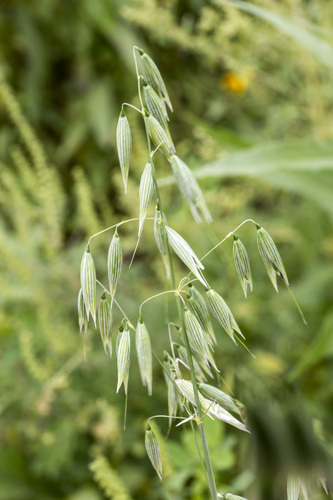
Common Oat
Avena sativa
The Common Oat is more than just a farm staple; it's a golden beacon for backyard wildlife. Its elegant, drooping seeds and hardy nature make it a fascinating subject for any nature observer.
Quick Identification
Size
Stands 60–150 cm (24–60 inches) tall with leaves 15–30 cm (6–12 inches) long
Colors
Bright bluish-green foliage turning to a pale golden-straw color as it matures
Key Features
- Loose, drooping branched flower heads called panicles
- Hollow, jointed stems (culms)
- Broad, flat leaf blades with a rough texture
- Large, pendulous spikelets that contain two or three seeds
When You’ll See Them
Geographic range
Where Does the Common Oat Live?
Originally native to the Fertile Crescent and Mediterranean regions of Europe and Western Asia, the Common Oat has been spread by humans across every temperate continent on Earth. It is now widely naturalized throughout the United States, Canada, and Northern Europe, where it thrives in the cool, moist summer climates these regions provide. While primarily an agricultural crop, 'volunteer' populations are commonly found in suburban gardens and disturbed lands throughout the temperate zones of both the Northern and Southern Hemispheres.
Basemap © OpenStreetMap contributors
Behavior
The Common Oat is a fast-growing annual grass that plays a foundational role in many backyard and rural ecosystems. Unlike perennial grasses that return year after year from the same roots, the oat completes its entire life cycle in a single growing season. It is known for its vigor and ability to outcompete weeds, often forming thick, swaying stands that provide vital low-level cover for small mammals like voles and ground-nesting birds such as quails.
While it is a stationary plant, it exhibits a dynamic presence in the landscape. Its heavy, drooping seed heads react sensitively to the wind, creating a characteristic rustling sound and rhythmic motion that is a hallmark of summer meadows. As the seeds ripen, the plant becomes a hub of activity, providing a high-protein food source that attracts a wide variety of wildlife from early morning until dusk.
EverydayEarth exclusive
Camera Tips
To capture the most striking images of Common Oat, position your camera at a low 'worm’s-eye' angle, roughly 12 to 18 inches above the ground. This perspective emphasizes the height of the stalks and frames the intricate, drooping seed heads against the sky. This height is also ideal for capturing the small songbirds, like Goldfinches and House Sparrows, that frequently land directly on the oat panicles to feed on the ripening grain.
Because oat stalks are highly susceptible to wind, they can cause frequent 'false triggers' on motion-activated cameras. To mitigate this, increase your camera's trigger speed or adjust the sensitivity settings to 'Medium.' If your camera allows for it, use a short video mode rather than still photos; the swaying of the golden oats in a breeze is much more visually compelling and provides a more natural look at the backyard environment.
Lighting is your best friend when photographing this species. Aim your camera toward the east or west to take advantage of 'Golden Hour' backlighting. When the sun is low, it catches the fine hairs (awns) and the translucent husks of the oat seeds, making the entire plant appear to glow. This effect creates professional-quality footage that highlights the texture of the grass beautifully.
Finally, use the oats as a natural attractant for wildlife monitoring. Place your camera near a dense patch of oats that has begun to turn from green to gold. This transition signals a high-energy food source for local fauna. You are likely to capture rare footage of small mammals foraging at the base of the stalks or even larger herbivores like deer browsing on the young, tender foliage during the early morning hours.
Similar Species
Species that look similar or are commonly confused with Common Oat.
Frequently Asked Questions
Record Common Oat at your habitat
Connect a camera to start building your own species record — AI identifies every visitor automatically.