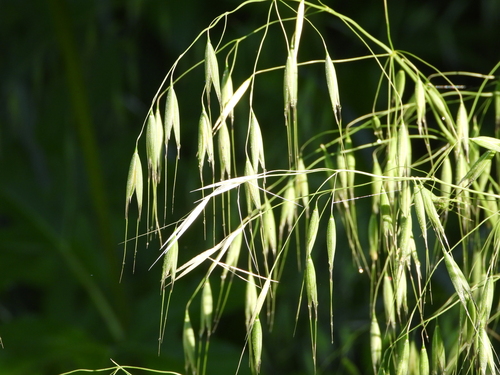
wild oat
Avena fatua
A resilient traveler from Eurasia, the wild oat is a master of self-planting and survival. With its elegant, drooping seed heads and 'crawling' awns, it transforms common garden edges into a dynamic landscape for local birds and insects.
Quick Identification
Size
Stands 30 to 150 cm (1 to 5 feet) tall; leaves are 10 to 45 cm (4 to 18 inches) long and up to 15 mm wide.
Colors
Bright green foliage when young, maturing to a light straw or golden-yellow hue; seeds often feature dark brown or reddish hairs at the base.
Key Features
- Drooping, pendulous spikelets resembling miniature lanterns
- Long, bent, and twisted awns (bristles) protruding from the seeds
- Hairy seed base (lemma) which distinguishes it from cultivated oats
- Hollow, upright stems with prominent nodes
When You’ll See Them
Geographic range
Where Does the wild oat Live?
Originally native to the temperate regions of Eurasia and North Africa, the wild oat has successfully naturalized across nearly every temperate zone on Earth. It is now a ubiquitous presence throughout the United States, Canada, and much of Europe, and has established significant populations in Australia and temperate South America. This global spread is largely due to its historical role as a companion to human grain migration, flourishing wherever the soil has been turned for farming or gardening.
Basemap © OpenStreetMap contributors
Behavior
Wild oat is an annual grass known for its remarkable survival strategies. Unlike domestic oats, which hold onto their seeds, the wild oat 'shatters' at maturity, dropping its seeds to the ground to ensure the next generation. This species is famous for its 'crawling' seeds; the long awns are hygroscopic, meaning they twist and untwist in response to changes in humidity. This mechanical movement actually helps drill the seed into the soil, effectively planting itself without any human intervention.
In a backyard setting, wild oats often act as a pioneer species, quickly colonizing patches of bare or disturbed earth. While many gardeners view them as a weed, they provide significant structure to the micro-habitat. They serve as a vital host for various larvae and provide high-energy seeds for granivorous birds and small rodents during the late summer and autumn months.
EverydayEarth exclusive
Camera Tips
Capturing the wild oat on camera requires a different approach than filming moving animals. To truly see this plant 'in action,' set your AI-powered camera to time-lapse mode during the peak of summer. This allows you to witness the fascinating mechanical movement of the awns as they twist in response to the morning dew and the drying afternoon sun, a process that looks almost insect-like when sped up.
For the best visual results, position your camera at a low 'worm’s-eye' angle (about 10-20 cm off the ground) facing toward the sun during the golden hour (early morning or late evening). The backlit husks and long awns will glow, creating a beautiful halo effect that makes for stunning nature photography. Because these plants sway significantly in the wind, ensure your camera is mounted on a very stable stake to prevent motion blur in the background while the plant dances.
If you are using a trigger-based camera to capture wildlife, be aware that tall wild oats can cause 'false triggers' on windy days. To turn this into an advantage, place your camera so the oats are in the mid-ground. They act as excellent natural indicators of wind speed and direction, and you'll often catch birds like goldfinches or sparrows perching on the stalks to feed on the ripening grain. Setting a high shutter speed is essential if you want to freeze the motion of the swaying stalks.
Similar Species
Species that look similar or are commonly confused with wild oat.
Frequently Asked Questions
Record wild oat at your habitat
Connect a camera to start building your own species record — AI identifies every visitor automatically.