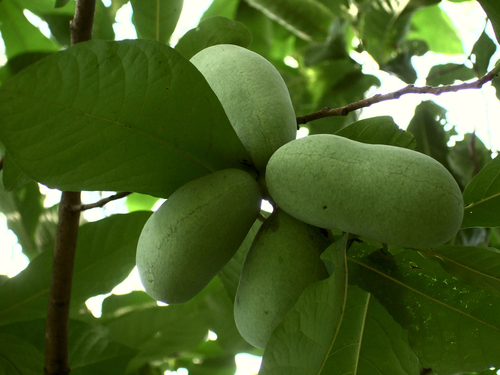
common pawpaw
Asimina triloba
Discover the 'Indiana Banana,' a tropical-looking native tree that hosts rare butterflies and produces North America's largest wild fruit.
Quick Identification
Size
Height: 5–10 m (15–33 ft); trunk diameter: 20–30 cm (8–12 in); leaf length: 25–30 cm (10–12 in)
Colors
Deep green leaves turning golden-yellow in fall; maroon or brownish-purple bell-shaped flowers; pale green fruit ripening to yellow-black
Key Features
- Large drooping tropical-looking leaves
- Small maroon 6-petaled flowers
- Large oblong green fruit with custard-like flesh
- Smooth grey bark with white blotches
- Forms dense clonal thickets
When You’ll See Them
Geographic range
Where Does the common pawpaw Live?
Native to the North American continent, the common pawpaw is a staple of the Eastern United States and parts of the Midwest. Its core range extends from northern Florida and the Gulf Coast up to southern Ontario, Canada, and as far west as eastern Nebraska and Texas. It is most commonly found flourishing in the fertile soils of the Ohio and Mississippi River valleys.
Basemap © OpenStreetMap contributors
Behavior
The common pawpaw is a unique understory tree that often grows in clonal patches, spreading via underground root suckers to form dense "pawpaw patches." Unlike many fruit trees that rely on bees, the pawpaw produces maroon flowers that emit a faint scent of rotting meat to attract carrion flies and beetles for pollination. It is a slow-growing species that thrives in the shaded protection of taller hardwoods but requires more sunlight to produce a heavy fruit crop.
This tree plays a vital role in its local ecosystem as the exclusive host plant for the Zebra Swallowtail butterfly larvae. In the late summer and early fall, the tree produces the largest edible fruit native to North America, often called the "Indiana Banana." These fruits are a high-energy resource for a variety of forest wildlife, though the tree itself is remarkably deer-resistant due to insecticidal acetogenins in its leaves and bark.
EverydayEarth exclusive
Camera Tips
To capture the full life cycle of a pawpaw patch, mount your camera at chest height facing the trunk and lower branches during the spring. This is the best time to document the emergence of the Zebra Swallowtail butterfly, which specifically seeks out pawpaw leaves to lay eggs. Use a camera with a good macro or close-focus capability to capture the unusual maroon flowers that bloom before the leaves fully unfurl.
During the late summer (August to October), transition your camera to a ground-level or low-angle setup. Pawpaw fruit often falls to the forest floor when ripe, creating a high-traffic bait station for nocturnal mammals. Position the camera about 2–3 meters away from a cluster of ripening fruit to capture raccoons, opossums, foxes, and even black bears that visit the patch for a sugary feast. Because these visitors are often active at night, ensure your camera has a high-quality infrared flash that won't overexpose the light-colored fruit.
For those interested in time-lapse photography, the pawpaw is an excellent subject due to its dramatic seasonal changes. The large, drooping leaves offer a distinct silhouette that changes from vibrant green to a brilliant, glowing gold in the fall. Setting your camera to take one photo per day from the same position will create a stunning visual record of the forest understory's transition.
Similar Species
Species that look similar or are commonly confused with common pawpaw.
Frequently Asked Questions
Record common pawpaw at your habitat
Connect a camera to start building your own species record — AI identifies every visitor automatically.