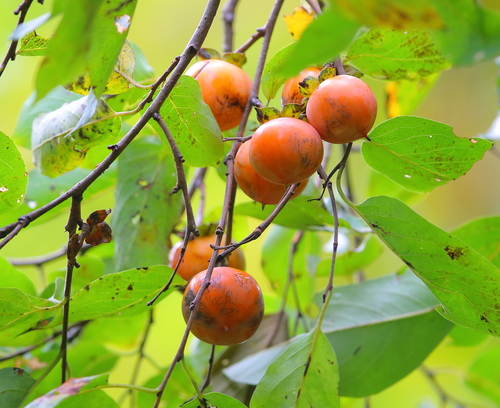
American persimmon
Diospyros virginiana
Often called the 'sugar plum' of the forest, the American persimmon is a hardy native tree famous for its sweet autumn fruit and distinctive 'alligator' bark. It serves as a vital community hub for backyard wildlife, from hungry deer to nocturnal opossums.
Quick Identification
Size
Typically 10–24 meters (35–80 feet) tall with a trunk diameter of 30–60 cm (12–24 inches).
Colors
Dark grey to nearly black blocky bark; lustrous dark green leaves; orange to reddish-purple fruit when ripe.
Key Features
- Distinctive 'alligator-skin' bark with deep square blocks
- Simple, ovate, glossy dark green leaves 7-15 cm long
- Small, fleshy orange fruit with a persistent woody calyx
- Dioecious habit with separate male and female trees
- Hard, dense wood with dark heartwood
When You’ll See Them
Geographic range
Where Does the American persimmon Live?
Native to the North American continent, the American persimmon thrives across a vast swath of the Eastern and Central United States. Its core range stretches from the southern coast of Connecticut down to the tip of Florida, reaching westward into the Great Plains across Texas, Oklahoma, Kansas, and Iowa. This hardy tree is particularly common in the Mississippi Valley and the Appalachian foothills, where it readily colonizes old pastures and sunny woodland borders.
Basemap © OpenStreetMap contributors
Behavior
The American persimmon is a resilient deciduous tree known for its slow growth and incredibly dense wood, which was historically used for golf club heads and billiard cues. As a dioecious species, it has a unique social dynamic where trees are gendered; only the female trees produce the famous 'sugar plum' fruits, while male trees provide the necessary pollen. In the spring, they produce inconspicuous, bell-shaped blossoms that are highly attractive to honeybees, making the tree an important early-season nectar source.
The tree's most notable 'behavior' is its fruit-ripening cycle. The fruit is famously astringent and bitter due to high tannin content until it reaches peak ripeness, which usually occurs after the first frost in autumn. As the fruit softens and wrinkles, it loses its bitterness and becomes a sugary, custard-like treat. This strategic timing ensures that the tree provides a high-energy food source for local wildlife exactly when other forage becomes scarce in the late fall and early winter.
EverydayEarth exclusive
Camera Tips
Capturing the American persimmon on your backyard camera is less about the tree moving and more about the incredible wildlife theater that happens around it. To catch the most action, you must first identify a female tree—the one that actually bears fruit. Mount your camera about 2 to 3 feet off the ground, angled slightly upward toward the lower branches or centered on the patch of ground where ripe fruit is beginning to fall. Because these fruits are a high-energy 'magnet' for animals, you can expect a parade of visitors including white-tailed deer, raccoons, opossums, and even grey foxes.
Set your camera to 'Video' or 'Hybrid' mode with a short trigger interval. The peak season for activity is late autumn, so October through December is your prime window. During this time, the persimmon tree becomes a nightly banquet hall. Using a camera with high-quality night vision is essential, as much of the feeding activity occurs under the cover of darkness. No-glow infrared is particularly recommended if you are hoping to catch more elusive visitors like foxes or coyotes who might be spooked by standard LEDs.
Don't just focus on the ground; if your camera has a wide-angle lens, try to capture the mid-section of the tree as well. Many birds, such as cedar waxwings, robins, and pileated woodpeckers, will visit the canopy to pluck fruit directly from the stems. If you have a trail camera with a time-lapse feature, you can also document the fascinating process of the fruit ripening and wrinkling over several weeks. Position the camera North or South to avoid sun glare during the golden hours when deer are most likely to visit for a sweet snack.
Similar Species
Species that look similar or are commonly confused with American persimmon.
Frequently Asked Questions
Record American persimmon at your habitat
Connect a camera to start building your own species record — AI identifies every visitor automatically.