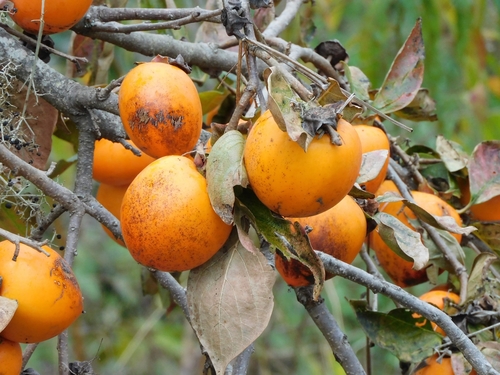
Japanese Persimmon
Diospyros kaki
A majestic ornamental tree famous for its 'honey-heart' fruits that persist through the winter. The Japanese Persimmon is a top-tier backyard attractant for everything from pollinators to wintering birds.
Quick Identification
Size
Height: 4.5–18 meters (15–60 feet); Canopy spread: 5–10 meters (15–33 feet)
Colors
Glossy dark green leaves turning orange-red in fall; bright orange tomato-shaped fruit; grey-brown blocky bark
Key Features
- Large glossy ovate leaves
- Bright orange, tomato-shaped fruit persisting after leaf drop
- Dark grey-brown bark with a blocky, alligator-skin texture
- Four-lobed woody green calyx at the base of the fruit
When You’ll See Them
Geographic range
Where Does the Japanese Persimmon Live?
Originally native to the subtropical and temperate regions of Central and Southern China, the Japanese Persimmon has been cultivated across East Asia for over 2,000 years. It is now a common sight in Japan and Korea, where it is deeply embedded in the cultural landscape. Beyond its native continent, the species has successfully established itself in Mediterranean climates and temperate zones worldwide, including the southern United States, California, Southern Europe, and parts of Australia and South America.
Basemap © OpenStreetMap contributors
Behavior
The Japanese Persimmon, or Kaki, is a slow-growing deciduous tree that acts as a vital hub for backyard biodiversity. Unlike many fruiting species that drop their harvest at the first frost, the Kaki is famous for its persistence. The fruit often remains clinging to the bare branches long after the leaves have fallen, creating a striking visual of orange globes against a winter sky and providing a critical sugar source for wildlife when other food becomes scarce.
Ecologically, the tree follows a predictable seasonal rhythm that dictates animal visits. In late spring, its inconspicuous, honey-scented flowers attract a wide array of pollinators. As the fruit ripens in late autumn, the tree becomes a focal point for social interaction among various species. It is not uncommon to see birds feeding in the canopy while mammals scavenge fallen fruit below, creating a multi-tiered feeding station in a single backyard location.
EverydayEarth exclusive
Camera Tips
To capture the best wildlife footage around a Japanese Persimmon, focus your efforts on the 'ripening window' between October and December. For ground-dwelling visitors like raccoons, foxes, and opossums, place your camera on a stake approximately 2 feet off the ground, about 10 feet away from the trunk. Angle the lens toward a patch where fallen fruit is likely to collect. This 'ground buffet' is a high-traffic area during the night, so ensure your infrared flash is enabled and your sensitivity is set to high to catch quick movements.
For avian enthusiasts, the Japanese Persimmon offers a unique opportunity to film birds at eye level. Mount your camera directly to a sturdy branch or use a high-angle tripod to focus on a specific cluster of fruit in the outer canopy. Cedar Waxwings, Blue Jays, and Orioles are frequent visitors. Use a fast shutter speed or high-frame-rate video setting (60fps) to capture the quick, jerky movements of birds as they peck at the fruit. Because the fruit is bright orange, it provides excellent contrast for AI-powered cameras to lock focus and trigger recording.
Be mindful of the 'white-out' effect during nighttime captures. The waxy skin of the persimmon can be highly reflective; if your camera's IR LEDs are too close to the fruit, it may appear as a glowing white orb. To prevent this, position the camera at a slight 45-degree angle to the fruit rather than pointing directly at it. If you are using a trail camera with a 'Burst' or 'Photo + Video' mode, this is the perfect time to use it, as animals often spend several minutes interacting with a single fruit, providing ample opportunity for high-quality multi-media captures.
Similar Species
Species that look similar or are commonly confused with Japanese Persimmon.
Frequently Asked Questions
Record Japanese Persimmon at your habitat
Connect a camera to start building your own species record — AI identifies every visitor automatically.