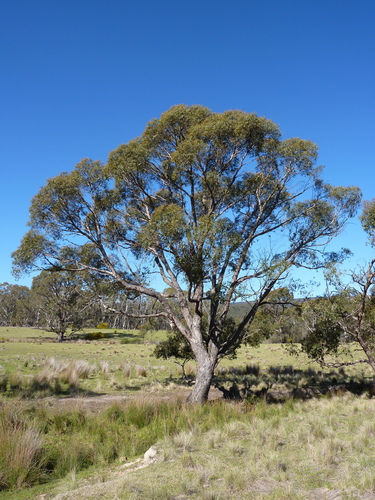
Black Gum
Eucalyptus aggregata
A hardy survivor of Australia's frost-prone tablelands, the Black Gum is a vital refuge for high-altitude wildlife. Its iconic rough bark and nectar-rich flowers make it a cornerstone of the southeastern grassy woodlands.
Quick Identification
Size
Height of 12–20 metres (39–66 ft); trunk diameter typically up to 1 metre (3.3 ft)
Colors
Dark grey to blackish rough bark; dark green to olive-green foliage; creamy white flowers
Key Features
- Rough, flaky, and deeply fissured bark on the trunk
- Narrow lance-shaped leaves, 5-12 cm long
- Flower buds occurring in distinct clusters of seven
- Small, hemispherical or cup-shaped woody fruit
When You’ll See Them
Geographic range
Where Does the Black Gum Live?
The Black Gum is a specialist tree native to the temperate high-country of southeastern Australia. Its primary range is concentrated in the Central and Southern Tablelands of New South Wales, extending into the colder, elevated regions of western Victoria, where it clings to the edges of swamps and streams.
Basemap © OpenStreetMap contributors
Behavior
The Black Gum is a resilient, slow-growing hardwood adapted to some of the most challenging conditions in southeastern Australia. Unlike many eucalypts that prefer well-drained slopes, the Black Gum thrives in 'frost hollows' and poorly drained, swampy flats where cold air settles and soil remains damp for much of the year.
As a foundational species in grassy woodlands, it provides a vital structural element for its ecosystem. While it doesn't 'behave' in the animal sense, it interacts with its environment by acting as a massive carbon sink and a moisture regulator in riparian zones. Its rough, persistent bark provides an intricate micro-habitat for a vast array of invertebrates, which in turn attract insectivorous birds.
For humans, the Black Gum is a symbol of the high-country landscape. Though it was historically cleared for grazing land, it is now highly valued for its ability to prevent soil erosion in wet areas and for the heavy, nectar-rich flowering displays that support local honey production and biodiversity.
EverydayEarth exclusive
Camera Tips
To capture the best of the Black Gum on your trail camera, you should treat the tree as the 'stage' rather than the 'subject.' Because the Black Gum is a major nectar source, the best camera placement is often on a neighboring tree or a sturdy post, angled upward toward the lower flowering branches. During the flowering season (late spring through autumn), high-speed trigger settings are essential to capture the rapid movements of honeyeaters and lorikeets that swarm the white blossoms.
For those interested in nocturnal visitors, the Black Gum's rough bark is a favorite climbing surface for arboreal mammals like the Sugar Glider or the Common Brushtail Possum. Position your camera about 2-3 metres up the trunk, facing a horizontal limb or a known 'highway' branch. Use a low-intensity infrared flash to avoid overexposing the pale, creamy flowers or the reflective surfaces of the leaves.
Time-lapse mode is a fantastic way to document the seasonal cycle of this species. Setting your camera to take one or two photos a day over several months will reveal the dramatic transition from tight, green buds to the 'explosion' of white stamens, and finally to the development of the woody, cup-shaped seed capsules. Ensure your camera is securely tethered to prevent 'wind-sway' from ruining the time-lapse sequence.
Since Black Gums grow in wet, boggy areas, ensure your camera housing is rated for high humidity. Using desiccant packs inside the camera case is highly recommended to prevent lens fogging, which is common in the damp, cold morning air of the Australian tablelands.
Similar Species
Species that look similar or are commonly confused with Black Gum.
Frequently Asked Questions
Record Black Gum at your habitat
Connect a camera to start building your own species record — AI identifies every visitor automatically.