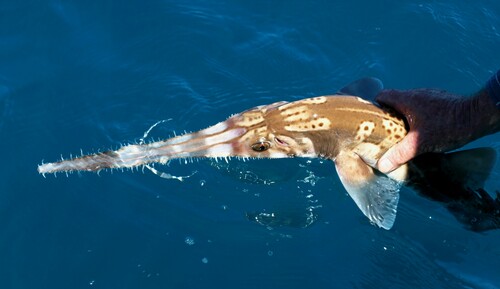
Common Sawshark
Pristiophorus cirratus
Equipped with a toothy 'saw' and sensitive whiskers, the Common Sawshark is a master of Australia's southern seafloors. This nocturnal specialist blends perfectly with the sand as it hunts for its next meal using advanced biological sensors.
Quick Identification
Size
Typically 1.1 to 1.4 metres (3.6 to 4.6 feet) in length; weight usually between 1.5 and 4.5 kg (3.3-10 lbs)
Colors
Pale yellow-brown to sandy grey on the dorsal side with faint darker blotches; creamy white or pale underside
Key Features
- Extremely long, flattened snout lined with sharp, unequal teeth
- Two long, fleshy barbels located halfway down the rostrum
- Slender, shark-like body with two dorsal fins and no anal fin
- Large eyes and five lateral gill slits
When You’ll See Them
Geographic range
Where Does the Common Sawshark Live?
This unique shark is endemic to the temperate and subtropical waters of the Australian continent. It is primarily found along the southern coastline, stretching from the northern waters of New South Wales, around the southern coast (including Tasmania), and up into the mid-latitudes of Western Australia. Within this range, it occupies the vast continental shelf, rarely venturing into the deep open ocean far from the coast.
Basemap © OpenStreetMap contributors
Behavior
The Common Sawshark is a fascinating, bottom-dwelling predator that navigates the seafloor with a prehistoric grace. Unlike the more famous sawfish (which are actually rays), the sawshark is a true shark, characterized by gill slits on the sides of its neck. It spends much of its time cruising just above sandy or silty substrates, using its highly specialized rostrum as both a sensory array and a lethal weapon. The barbels on its snout are packed with chemoreceptors and mechanoreceptors, allowing it to 'taste' and feel the water for the presence of prey hidden beneath the sand.
While generally solitary, Common Sawsharks are known to form loose aggregations, particularly during the breeding season or in areas with high food density. They are primarily nocturnal or crepuscular hunters, becoming most active as the sun sets. When prey is detected, the shark uses a rapid side-to-side slashing motion of its saw to stun or impale small fish and squid. Despite their intimidating appearance, they are non-aggressive toward humans and are generally shy, retreating quickly if disturbed by divers or submersible lights.
EverydayEarth exclusive
Camera Tips
Capturing the Common Sawshark requires a specialized approach since they reside in relatively deep marine environments. For coastal residents or researchers, a Baited Remote Underwater Video (BRUV) system is the most effective tool. Position your camera rig on sandy or silty flats adjacent to rocky reef edges at depths of at least 40 meters. The camera should be mounted horizontally on a stable frame, roughly 30 cm from the seabed, with a bait arm extending into the field of view to attract these curious predators.
Because sawsharks are highly sensitive to electrical signals (using their Ampullae of Lorenzini), it is vital to use high-quality, shielded camera housings. Unshielded electronics can produce a 'galvanic' signature that might either repel the shark or cause it to attack the camera equipment rather than the bait. For bait, oily fish with a high scent profile, such as sardines or chopped mackerel, works best to draw them in from the surrounding currents.
Since this species is most active during the night, infrared lighting or low-intensity red LEDs are recommended to avoid startling the animal. Standard white lights can often cause 'backscatter' in silty water and may spook the shark before it gets close enough for a clear ID. Set your camera to record in 10-15 minute intervals with high-sensitivity sensors enabled. If you are operating from a pier or boat near a drop-off, ensure the rig is heavily weighted to prevent it from drifting in the strong southern Australian currents.
Similar Species
Species that look similar or are commonly confused with Common Sawshark.
Frequently Asked Questions
Record Common Sawshark at your habitat
Connect a camera to start building your own species record — AI identifies every visitor automatically.