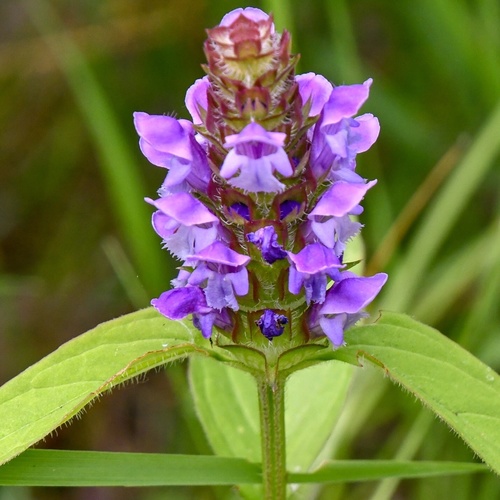
common selfheal
Prunella vulgaris
A resilient survivor found in lawns and meadows worldwide, common selfheal is much more than a weed—it is a vital nectar source for backyard pollinators and a historical staple of herbal medicine.
Quick Identification
Size
Stands 5–30 cm (2–12 inches) tall with flower spikes measuring 2–5 cm (0.8–2 inches) in length.
Colors
Features vibrant violet to deep purple tubular flowers with dark green, lance-shaped leaves that can sometimes develop a reddish-purple tint along the margins.
Key Features
- Distinctive square-shaped stems common to the mint family
- Opposite, egg-shaped leaves with lightly toothed or smooth edges
- Dense, club-like terminal flower spikes that appear bristly
- Individual flowers have a hooded upper lip and a fringed, paler lower lip
When You’ll See Them
Geographic range
Where Does the common selfheal Live?
Common selfheal is a truly cosmopolitan species native across the temperate regions of North America, Europe, and Asia. It is ubiquitous throughout the United States and Canada, frequently appearing in both high-altitude alpine meadows and sea-level coastal plains. Beyond its native range, it has successfully established populations in parts of South America, Africa, and Australia, making it one of the most widely distributed wildflowers on the planet.
Basemap © OpenStreetMap contributors
Behavior
Ecologically, selfheal acts as a vital community hub. It is a 'generalist' nectar provider, meaning its flower structure is accessible to a wide variety of tongue lengths. Throughout its blooming season, the plant effectively manages its nectar production to stay attractive to pollinators from morning until late afternoon, ensuring that it remains a consistent food source for the local insect population even during mid-summer heatwaves.
EverydayEarth exclusive
Camera Tips
Since the plant itself doesn't move much, the 'action' comes from its visitors. Set your camera to 'Video' or 'Burst' mode with a high trigger sensitivity. Selfheal is a magnet for bumblebees, hoverflies, and small butterflies like the Cabbage White. By focusing your camera on a healthy patch of blooms during a sunny day, you are essentially setting a trap for some of the most colorful insect photography possible in a backyard setting.
If your camera supports macro or close-focus settings, place it approximately 12 to 18 inches away from the flower head. This distance is the 'sweet spot' for capturing the intricate fringed detail of the lower petal lip. If you are using an AI-powered camera that triggers on movement, ensure there aren't long blades of grass directly in front of the lens that might trigger the sensor during a breeze, causing 'false positives' and draining your battery.
Lighting is the final key. The deep violet color of selfheal can look muddy in low light or 'blown out' in harsh midday sun. The best footage is usually captured during the 'golden hours' of early morning or late afternoon. The soft, side-angled light highlights the fine white hairs on the plant's square stem and the velvet texture of the petals. During the winter, don't move your camera; the dried, brown seed heads often attract small foraging birds like goldfinches, providing a whole new set of subjects.
Similar Species
Species that look similar or are commonly confused with common selfheal.
Frequently Asked Questions
Record common selfheal at your habitat
Connect a camera to start building your own species record — AI identifies every visitor automatically.