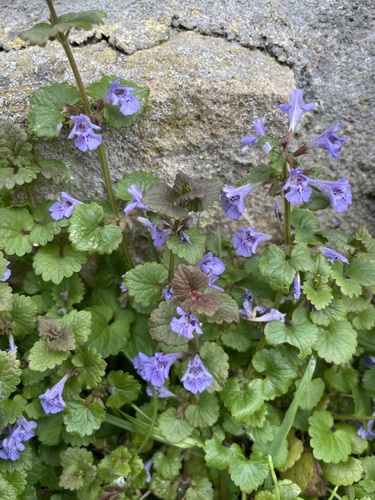
ground-ivy
Glechoma hederacea
A fragrant, creeping treasure of the spring garden, ground-ivy creates a lush purple carpet that serves as one of the year's first feasts for hungry bees.
Quick Identification
Size
Stems creep 20–50 cm (8–20 in) along the ground; leaves 1–3 cm (0.4–1.2 in) in diameter.
Colors
Dark green to purplish-green leaves; bluish-violet or lavender flowers with tiny dark purple spots.
Key Features
- Scalloped, kidney-shaped leaves with prominent veins
- Square stems that creep along the ground
- Tubular, two-lipped purple flowers in small clusters
- Strong aromatic scent when leaves are crushed or stepped on
When You’ll See Them
Behavior
Ground-ivy is a resilient, low-growing perennial that spreads vigorously through stolons (horizontal runners). These runners root at the nodes, allowing the plant to form a dense, carpet-like ground cover that can quickly colonize lawns and garden beds. It is often one of the first plants to wake up in the spring, providing an early splash of green and purple before most other backyard flora emerges.
As a member of the mint family, it is highly aromatic. Historically known as 'Alehoof,' it was used to clarify and flavor beer before hops became the industry standard. While many modern gardeners consider it a stubborn weed due to its ability to survive mowing and shading, it plays a vital ecological role by stabilizing soil and providing a critical early-season nectar source for bees and other pollinators.
EverydayEarth exclusive
Camera Tips
Capturing ground-ivy requires a different approach than filming mobile wildlife. To showcase its growth, position your camera on a low-profile ground mount or a very short tripod. The lens should be roughly 4 to 6 inches above the soil, angled slightly downward. This 'bug's-eye view' allows you to capture the intricate scalloped edges of the leaves and the vertical purple flowers that stand up from the creeping stems.
Since plants don't trigger standard PIR motion sensors, the Time-Lapse mode is your best tool. Set your camera to take a photo every 30 minutes during daylight hours over the course of a week in April or May. When played back, you’ll see the fascinating 'creeping' motion of the runners as they search for new soil and the daily opening and closing of the blossoms.
To capture the wildlife associated with ground-ivy, place your camera near a flowering patch on a warm, sunny morning. Ground-ivy is a magnet for early-season pollinators like mason bees, honeybees, and hoverflies. Use a high-sensitivity motion setting or a 'Fast' trigger speed to catch these small, quick-moving visitors as they land on the tiny tubular flowers.
Lighting is crucial for this species. Bright, direct midday sun can wash out the delicate purple hues of the flowers. Aim to capture your best shots during the 'golden hours' of shortly after sunrise or before sunset, which will highlight the texture of the leaves and the fine hairs on the stems. If your camera has a macro lens or adjustable focus, set it for close-up range (within 1-2 feet) to see the beautiful dark spots inside the flower throat.
Similar Species
Species that look similar or are commonly confused with ground-ivy.
Frequently Asked Questions
Record ground-ivy at your habitat
Connect a camera to start building your own species record — AI identifies every visitor automatically.