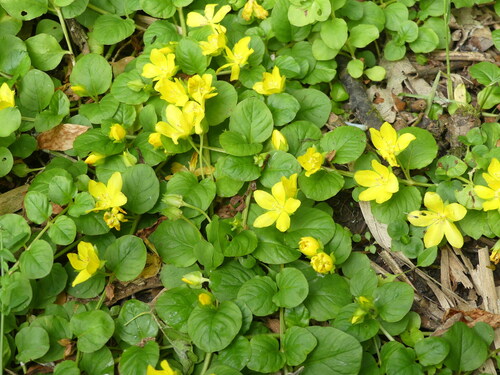
creeping Jenny
Lysimachia nummularia
A shimmering carpet of coin-shaped leaves and sun-yellow blooms, creeping Jenny turns damp garden corners into vibrant wildlife runways. This resilient perennial is a master of the moist ground, providing essential cover for backyard critters.
Quick Identification
Size
Height of 5-10 cm (2-4 inches); trailing stems can reach 30-90 cm (1-3 feet) in length
Colors
Bright lime-green to emerald-green foliage with cup-shaped, brilliant yellow flowers
Key Features
- Opposite, coin-shaped (orbicular) leaves
- Low-growing, mat-forming creeping stems
- Bright yellow five-petaled flowers blooming in leaf axils
- Smooth, hairless stems that root at the nodes
When You’ll See Them
Geographic range
Where Does the creeping Jenny Live?
Creeping Jenny is native to the temperate regions of Europe and Western Asia, where it is a common sight in naturally damp river valleys and deciduous forests. It has been widely introduced to North America as an ornamental plant and has naturalized across most of the United States and Southern Canada, frequently appearing in the wild near human settlements. It also maintains established populations in parts of New Zealand and Australia, thriving anywhere that offers consistent ground moisture and partial shade.
Basemap © OpenStreetMap contributors
Behavior
While it is largely stationary, its 'behavior' is most evident in its response to moisture and light. The plant is a hydrophyte, showing a strong preference for wet environments and often leaning toward water sources. During the summer months, it produces a flush of nectar-filled flowers that serve as a significant resource for specialized bees and hoverflies, making it a micro-hub of activity in a backyard ecosystem.
EverydayEarth exclusive
Camera Tips
Capturing the growth of creeping Jenny requires a different approach than filming moving wildlife. Use a camera with a dedicated macro mode or a close-focusing lens and mount it on a ground-level stake or a low-profile tripod. Because the plant only grows a few inches tall, the best shots are taken from a 'frog's eye view,' looking across the mat of leaves toward the flowers. This angle emphasizes the 'moneywort' shape of the leaves and provides a cinematic look at the yellow blooms.
For the best results with an AI-powered camera, set it to a time-lapse mode during the peak growing season of June and July. Positioning the camera to take one photo every hour during daylight can create a fascinating video of the stems 'inching' across the soil and the flowers opening and closing in response to the sun. If you want to capture the animals that visit creeping Jenny, place your camera near a flowering patch on a sunny morning. The bright yellow flowers are a magnet for pollinators like the Macropis bee, which collects oils and pollen specifically from Lysimachia species.
Since creeping Jenny thrives in very wet areas, lens fogging can be an issue. Ensure your camera housing is well-ventilated or use anti-fog inserts. If you are placing a trail camera in a damp garden or near a creek to catch wildlife using the plant as cover, angle the camera slightly downward from a height of 12 inches. This allows you to see small amphibians like toads or salamanders that often hide beneath the cool, damp leaves of the creeping Jenny mat during the heat of the day.
Similar Species
Species that look similar or are commonly confused with creeping Jenny.
Frequently Asked Questions
Record creeping Jenny at your habitat
Connect a camera to start building your own species record — AI identifies every visitor automatically.