Common Mallow
Malva sylvestris
A resilient traveler with striking purple-veined petals, the Common Mallow turns roadsides and gardens into bustling hubs for pollinators. Known for its edible 'cheese' fruits and medicinal history, it is a hardy staple of the temperate backyard.
Quick Identification
Size
Stands 30–120 cm (1–4 ft) tall with a spread of 45–60 cm (1.5–2 ft)
Colors
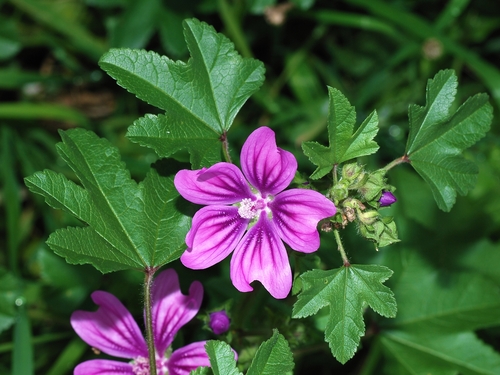
Bright purple, mauve, or pinkish-lilac petals with three dark violet longitudinal veins; deep green foliage
Key Features
- Five-petaled flowers with deeply notched tips
- Distinctive dark 'nectar guides' radiating from the center
- Lobed, heart-shaped leaves with hairy surfaces
- Circular fruit clusters resembling tiny wheels of cheese
When You’ll See Them
Geographic range
Where Does the Common Mallow Live?
Native to Western Europe, North Africa, and Southwest Asia, Common Mallow has successfully migrated across the globe. It is now widely naturalized throughout North America, from southern Canada to the United States, as well as parts of Australia and New Zealand. This adaptable species is a master of the temperate zone, flourishing anywhere from sea-level coastal plains to inland mountain foothills.
Basemap © OpenStreetMap contributors
Behavior
Common Mallow is a resilient biennial or perennial plant known for its striking floral display and robust growth habit. It acts as a focal point in the backyard ecosystem, serving as a primary nectar source for various bees, particularly honeybees and bumblebees, as well as a host plant for the Painted Lady butterfly. Its flowers follow the sun during the day, a phenomenon known as heliotropism, though less pronounced than in sunflowers.
Interaction with humans has a long history; the plant is entirely edible and was once a staple 'famine food.' The mucilaginous properties of the leaves and roots have been used in traditional medicine for centuries to soothe various ailments. In the garden, it is often viewed as a 'bridge' species that connects manicured lawns to wilder spaces, thriving in disturbed soils where other plants might struggle.
EverydayEarth exclusive
Camera Tips
To capture the vibrant life surrounding Common Mallow, place your AI-powered camera on a tripod or garden stake at a height of approximately 18 to 24 inches. This height allows you to capture both the intricate details of the blooms and the activity of visiting pollinators. Angle the camera slightly downward to get a clear view of the 'cheese' fruit clusters and the center of the flowers where insects land.
Common Mallow is an excellent subject for time-lapse photography. Set your camera to take a photo every 15–30 minutes during the peak summer months to witness the rapid growth of the stalks and the daily opening and closing of the blossoms. Because the plant can grow quite tall and sway in the breeze, choose a calm day for video recording to avoid motion-blur, or increase your shutter speed if your device allows for manual adjustments.
For the best lighting, capture images during the 'Golden Hour'—shortly after sunrise or before sunset. The low-angled light emphasizes the hairy texture of the leaves and the translucent quality of the purple petals. If you are specifically looking to trigger AI detection for insects, ensure the camera is focused on the most densely flowered part of the stalk, as these are the high-traffic zones for bees and butterflies.
Similar Species
Species that look similar or are commonly confused with Common Mallow.
Musk Mallow
Has deeply feathery, filigreed leaves compared to the broad, lobed leaves of the Common Mallow.
Dwarf Mallow
Much smaller growth habit with pale white or light pink flowers that lack the bold purple veining.
Tree Mallow
Features a woody base and can grow much taller, reaching up to 3 meters in coastal environments.
Frequently Asked Questions
Record Common Mallow at your habitat
Connect a camera to start building your own species record — AI identifies every visitor automatically.