Tree Mallow
Malva arborea
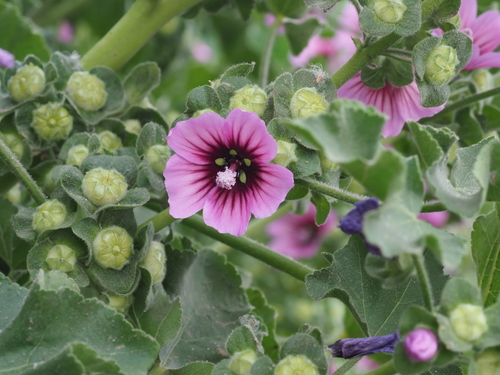
A towering coastal sentinel with velvet-soft leaves and striking purple-veined blooms. The Tree Mallow is a salt-hardy masterpiece that turns any seaside garden into a bustling pollinator sanctuary.
Quick Identification
Size
Stands 1-3 meters (3.3-9.8 feet) tall; flowers measure 3-4 cm (1.2-1.6 inches) in diameter.
Colors
Bicolor flowers featuring deep pink to lilac petals with prominent dark purple veins and a dark burgundy center; foliage is a soft, muted grey-green.
Key Features
- Tall, semi-woody stem that becomes trunk-like at the base
- Soft, velvety leaves with 5-7 shallow lobes
- Clusters of 2-7 funnel-shaped flowers in leaf axils
- Heart-shaped fruit segments (schizocarps) arranged in a circular 'cheese-wheel' shape
When You’ll See Them
Behavior
The Tree Mallow is a resilient biennial or short-lived perennial that exhibits a 'pioneer' growth strategy. In its first year, it typically focuses on developing a robust basal rosette of large, velvety leaves and a sturdy taproot. By its second year, it rapidly bolts upward, producing a towering, woody stem that can withstand the harsh, salt-laden winds of coastal environments. Unlike many delicate garden flowers, the Tree Mallow is built for endurance, using its fine hairs (trichomes) to trap moisture and reflect excess solar radiation.
As a key player in its ecosystem, the Tree Mallow acts as a critical nectar station. From late spring through mid-summer, its flowers open sequentially from the bottom of the stalk upward, providing a consistent food source for long-tongued bees, hoverflies, and butterflies. While it doesn't 'move' in the animal sense, it follows a strict circadian rhythm where flowers open in the morning light and close as the sun sets, a process known as nyctinasty that protects its pollen from overnight dampness.
EverydayEarth exclusive
Camera Tips
To capture the true essence of the Tree Mallow, position your camera at a mid-height level, roughly 3 to 5 feet off the ground. This 'flower-eye' view allows you to capture the intricate dark veining inside the petals and the busy pollinators that visit them. Because this plant can grow quite tall, avoid pointing the camera too far upward, which often results in 'blown-out' highlights against a bright sky; instead, try to angle it slightly downward or across to use the plant's own velvety foliage as a soft, contrasting background.
Since the Tree Mallow is a magnet for insects, use a camera with a fast trigger speed or a dedicated 'motion' mode. If your AI-powered camera allows for zone triggering, focus the 'hot zone' directly on a cluster of freshly opened blooms. The best time for capture is mid-morning, just after the dew has dried and the flowers have fully unfurled. This is when the light is soft enough to reveal the texture of the leaves without harsh shadows, and when pollinator activity is at its highest.
Time-lapse photography is particularly rewarding with this species. Set your camera to take a photo every 15-30 minutes over a 48-hour period. This will beautifully document the 'sequential blooming' of the stalk, showing lower flowers fading into seed heads while upper buds burst into color. If you are in a windy coastal area, ensure your camera mount is exceptionally secure, as the Tree Mallow’s height makes it prone to swaying, which can trigger false motion alerts.
In the winter months, don't take your camera down! The Tree Mallow maintains a striking silhouette even when not in bloom. The drying 'cheese-wheel' seed pods and the weathered, woody stem provide excellent architectural interest and attract small foraging birds that pick through the dried husks for seeds. For these shots, a side-lighting angle during the 'Golden Hour' (late afternoon) will emphasize the structural textures of the plant.
Similar Species
Species that look similar or are commonly confused with Tree Mallow.
Common Mallow
Much shorter and more sprawling than the Tree Mallow, lacking the woody, tree-like base.
Marsh Mallow
Has much paler pink flowers and prefers damp, marshy ground rather than dry coastal cliffs.
Hollyhock
While similar in height, Hollyhocks have larger, more varied flower colors and lack the distinct velvety leaf texture of the Tree Mallow.
Frequently Asked Questions
Record Tree Mallow at your habitat
Connect a camera to start building your own species record — AI identifies every visitor automatically.