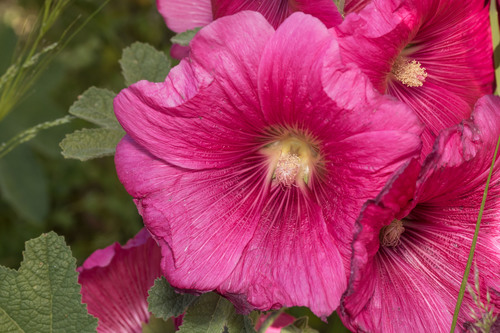
Hollyhock
Alcea rosea
Towering over the summer garden with spikes of vibrant, satiny blooms, the Hollyhock is a timeless icon of the backyard. These sun-loving giants are more than just beautiful—they are bustling hubs for hummingbirds and bees.
Quick Identification
Size
Height: 1.5–2.5 meters (5–8 feet); Flower diameter: 7–12 cm (3–5 inches)
Colors
Highly varied including white, pale pink, deep red, yellow, purple, and near-black maroon; often featuring a contrasting yellow or dark center.
Key Features
- Tall, sturdy, unbranched stalks reaching up to 8 feet
- Large, funnel-shaped flowers that bloom sequentially from bottom to top
- Broad, heart-shaped or lobed leaves with a rough, hairy texture
- Bracts located at the base of each flower spike
When You’ll See Them
Behavior
Hollyhocks are classic biennial or short-lived perennial plants that focus on root and leaf development in their first year, forming a low-lying rosette. In their second year, they undergo a dramatic growth spurt, sending up a towering spike of blooms that serves as a primary nectar source for large bees and hummingbirds. Because of their height and weight, they often lean toward the sun and may require the support of a fence or wall.
These plants are famous for their self-seeding behavior. Once a colony is established, the heavy seeds drop near the base of the parent plant, ensuring a rotating cycle of new rosettes and flowering spikes year after year. While they appear stationary, their blooms follow a rhythmic daily cycle, opening fully in the morning sun to invite pollinators and slowly closing or wilting as the individual flower's life cycle ends after a few days.
EverydayEarth exclusive
Camera Tips
To capture the full majesty of a Hollyhock, you need to think vertically. Set your camera on a tripod or mount it to a nearby post at about chest height (4-5 feet). Rather than pointing the camera down, aim it slightly upward at the mid-section of the flowering spike. This angle captures the sequential blooming pattern and provides a clear view of the interior of the funnel-shaped flowers where pollinators spend most of their time.
If your goal is to document wildlife visiting the Hollyhock, use a 'high-speed' or 'burst' photo mode. Hollyhocks are magnets for Bumblebees and Hummingbirds. Set your trigger interval to the shortest possible time to capture the rapid movement of wings. Because the flowers are deep, the best shots occur when a bee is partially submerged in the bloom or when a hummingbird hovers just inches away. Aim for the morning hours (7-10 AM) when nectar levels are highest and insect activity is most frequent.
For a unique perspective, try a time-lapse setting over the course of a week in mid-summer. Position the camera to frame the entire stalk against a clear background like a fence or the sky. By taking one photo every hour during daylight, you can create a stunning video showing the 'climb' of the blossoms as they open from the bottom of the stalk toward the tip.
Lighting is crucial for these vibrant plants. Avoid the harsh midday sun, which can wash out the delicate petal colors. The 'golden hour' shortly before sunset provides a warm, directional light that highlights the fuzzy texture of the stems and the intricate veining of the leaves. Ensure your camera is positioned so the sun is behind you or to the side to avoid lens flare, unless you are going for a dramatic backlit silhouette of the towering flower spike.
Similar Species
Species that look similar or are commonly confused with Hollyhock.
Frequently Asked Questions
Record Hollyhock at your habitat
Connect a camera to start building your own species record — AI identifies every visitor automatically.