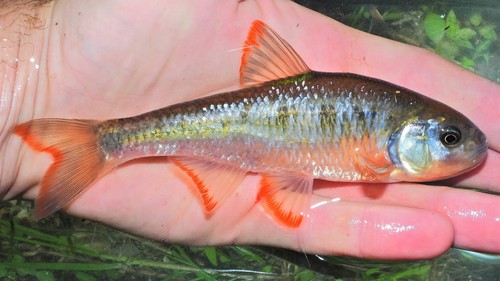
Common Shiner
Luxilus cornutus
A shimmering inhabitant of North American streams, the Common Shiner is a master of the underwater world, known for its brilliant silver scales and lively social behavior.
Quick Identification
Size
4–6 inches (10–15 cm) on average, with large adults reaching up to 8 inches (20 cm)
Colors
Bright silver sides with blue or purple iridescence; olive-green back with a dark central stripe; males develop pinkish-red fins and head bumps during spawning
Key Features
- Large diamond-shaped scales that are noticeably taller than they are wide
- Dark stripe running down the center of the back
- Deep-bodied profile compared to other slender minnow species
- Terminal mouth with no barbels
When You’ll See Them
Geographic range
Where Does the Common Shiner Live?
The Common Shiner is a quintessential North American native, thriving in the cool, clear waters of the northeastern United States and southeastern Canada. Its range extends from the Atlantic drainage in New England across the Great Lakes basin and westward into the prairies of the Dakotas and Nebraska. These adaptable minnows are most abundant in the mid-latitudes, where temperate climates provide the ideal seasonal temperature shifts they need for successful reproduction.
Basemap © OpenStreetMap contributors
Behavior
Common Shiners are energetic, schooling fish that bring life to clear, flowing waters. They are highly social and are almost always found in groups, often mixing with other species like dace or chubs. They are known as 'active' swimmers, frequently darting through the mid-water column or rising to the surface to snag drifting insects. Their presence is often a good indicator of water quality, as they prefer clear, oxygenated streams over murky or stagnant water.
One of their most fascinating behaviors is their 'nest association.' During the spring, Common Shiners often spawn over the gravel nests built by other fish, such as Creek Chubs or Nocomis species. This communal nesting helps protect their eggs from silt and predators. While they are generally shy of humans, they are curious and will often investigate areas where the stream bed has been disturbed, looking for an easy meal of dislodged invertebrates.
EverydayEarth exclusive
Camera Tips
To capture the Common Shiner, you will need to move your gear underwater. Standard trail cameras won't cut through the surface reflection, so a waterproof action camera or a trail cam in a specialized underwater housing is essential. For the best results, place your camera in a 'run'—the area of a stream with a steady, moderate current and a gravelly bottom. Position the camera low, roughly 4 to 6 inches above the substrate, and angle it slightly upward toward the water's surface to capture the silver flash of their scales as they catch the sunlight.
While you don't need traditional bait, you can 'lure' them into the frame by creating a natural feeding event. Gently scuff the rocks upstream of your camera with your foot; this releases aquatic insects and larvae into the current, which will quickly draw a school of shiners into your camera's field of view. This technique is particularly effective in the late morning when the sun is high enough to illuminate the water column.
During the peak spawning months of May and June, look for mounds of clean gravel in the stream. These are nests. Setting your camera near these sites can provide incredible footage of 'nuptial' males, which develop bright pink coloration and small bumps called tubercles on their heads. For the clearest video, set your camera to a high frame rate (at least 60fps) to keep up with their rapid, darting movements, and try to film on bright, sunny days when the water is at its clearest.
Similar Species
Species that look similar or are commonly confused with Common Shiner.
Frequently Asked Questions
Record Common Shiner at your habitat
Connect a camera to start building your own species record — AI identifies every visitor automatically.