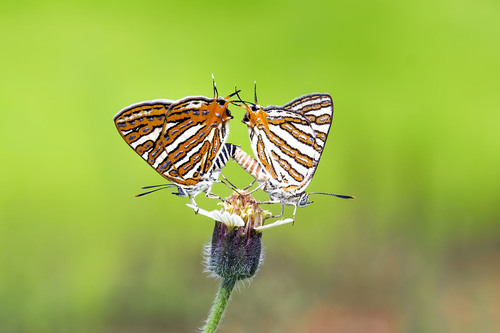
Common Silverline
Cigaritis vulcanus
A master of disguise with shimmering metallic accents, the Common Silverline is a jewel of the South Asian landscape. This small but feisty butterfly uses a 'false head' to outsmart predators and lights up gardens with its silver-streaked wings.
Quick Identification
Size
Wingspan of 26 to 34 mm (1.0 to 1.3 inches)
Colors
Tawny orange upper wings with dark borders; underside is creamy yellow with orange-red bands containing brilliant silver-blue metallic streaks.
Key Features
- Bright silver-blue metallic streaks centered within orange bands on the underside
- Two delicate, hair-like tails on each hindwing
- Prominent orange-and-black eyespots at the base of the hindwings
- Compact, rapid, and jerky flight pattern
When You’ll See Them
Geographic range
Where Does the Common Silverline Live?
The Common Silverline is native to the South Asian continent, where it enjoys a wide and stable distribution. Its core range is centered in India and Sri Lanka, extending westward into Pakistan and eastward through Nepal and Bangladesh. It is a highly adaptable species, thriving in both the humid tropical zones of the south and the more temperate foothills of the Himalayas.
Basemap © OpenStreetMap contributors
Behavior
The Common Silverline is a sun-loving butterfly known for its rapid and erratic flight. It is frequently seen basking on low-hanging leaves or visiting small wildflowers for nectar. Despite its small size, it is quite territorial; males are often seen perching in sunny spots, darting out to chase away intruders before returning to the same leaf. They are most active during the warmer hours of the day when the sun highlights their metallic markings.
One of its most fascinating behaviors is its 'false head' defense strategy. When at rest, the butterfly often wiggles its hindwings, causing the delicate tails and eyespots to mimic the movement of antennae and eyes. This misdirects predators, such as birds or spiders, into attacking the less vital rear end of the butterfly, allowing the Silverline to escape with only a minor wing tear. This species also maintains a symbiotic relationship with Crematogaster ants, which protect the larvae in exchange for sugary secretions.
EverydayEarth exclusive
Camera Tips
Capturing the Common Silverline on a backyard camera requires a focus on 'micro-habitats.' Because these butterflies are small, position your camera 12 to 24 inches away from nectar-rich flowers like Lantana or Marigolds. If your AI-powered camera has a macro lens attachment or a 'close-focus' setting, this is the time to use it. A side-on angle is best to capture the distinctive silver streaks on the underside of the wings, which are most visible when the butterfly is at rest with its wings closed.
Lighting is critical for this species. Place your camera in a spot that receives full morning sun, as the 'silver' in the Silverline is highly reflective and produces stunning results when hit by direct light. High-speed shutter settings are recommended if your camera allows adjustments, as their flight is incredibly fast. To attract them specifically, ensure you have host plants like Ziziphus nearby, which encourages them to stay in the area rather than just passing through.
For the best AI detection, ensure the background is relatively uncluttered. If the camera is struggling to trigger on a small insect, try setting it to a 'time-lapse' mode during peak sunny hours (10 AM to 2 PM) or increasing the motion sensitivity to its highest level. In backyard settings, a shallow birdbath nearby can also attract them on hot days, providing a secondary location for clear, stationary shots.
Similar Species
Species that look similar or are commonly confused with Common Silverline.
Frequently Asked Questions
Record Common Silverline at your habitat
Connect a camera to start building your own species record — AI identifies every visitor automatically.