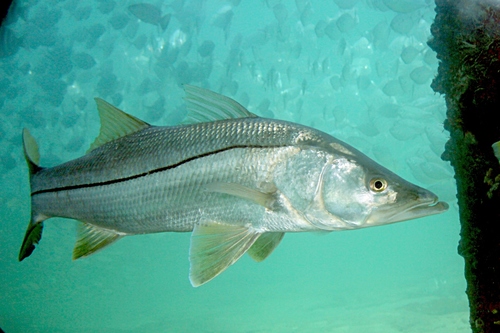
Common Snook
Centropomus undecimalis
Master of the mangroves and the king of the canal, the Common Snook is a sleek, powerful predator easily identified by its iconic 'racing stripe.' A favorite of backyard observers, this wary fish turns dockside lights into its personal hunting grounds.
Quick Identification
Size
Typically 45–90 cm (18–35 inches), but can reach 140 cm (55 inches); weight ranges from 2–23 kg (5–50 lbs).
Colors
Silvery sides with a golden or olive-green back and a white belly; characterized by a prominent, dark black lateral line.
Key Features
- Distinctive black lateral line running from gills to tail
- Large mouth with a protruding lower jaw
- Divided dorsal fins with high spines
- Sloping, concave forehead profile
When You’ll See Them
Sightings on EverydayEarth
Jul 23, 2026
A diverse group of fish is active in the clear spring water. Several Sheepshead swim prominently in the foreground and midground, occasionally approaching the camera. Smaller Gray Snappers and streamlined Common Snook move through the lower portion of the frame and near the algae-covered structure at the top of the scene.
Jul 23, 2026
Several species of fish are active in the crystal-clear water of the spring. A Sheepshead with vivid black stripes swims directly toward and past the camera lens. In the background, a Common Snook and several Gray Snappers glide near a submerged rectangular structure as sunlight filters through the surface.
Jul 12, 2026
In the crystal-clear water of Homosassa Springs, a West Indian manatee swims slowly near the surface, initially appearing to browse on floating vegetation. A large, diverse school of fish accompanies the manatee, including several Gray Snappers and a Sheepshead with its characteristic vertical stripes. A Common Snook is also visible, identified by its dark lateral line. The sunlight creates shimmering patterns on the sandy bottom and the manatee's back as it glides through the frame, eventually revealing its large paddle-shaped tail.
Jul 12, 2026
A West Indian manatee is seen swimming near the surface, feeding on floating lettuce. Below and around it, a large jubilee of fish including striped Sheepshead, Gray Snappers, and Common Snook swim through the clear spring water.
Jul 6, 2026
A school of fish swims through the clear, sunlit waters of the spring. Several Common Snook are visible in the foreground, identifiable by the sharp black lines running along their silver sides. Other fish, likely Gray Snapper, swim in the mid-ground and background. They appear to be drifting calmly with the gentle current near a submerged wooden structure.
Jul 6, 2026
A Common Snook swims slowly through the clear, sunlit water of the spring. The fish remains relatively still in the water column, adjusting its position with subtle fin movements. A floating structure with algae growth is visible at the surface above, and other smaller fish are occasionally visible in the distance.
Geographic range
Where Does the Common Snook Live?
Native to the subtropical and tropical waters of the Western Atlantic Ocean, the Common Snook is a coastal specialist. Its range begins as far north as the central Florida coast and extends through the Gulf of Mexico and the Caribbean Sea, following the coastline of Central and South America as far south as Rio de Janeiro, Brazil. Because they require warm water and protective estuaries for spawning, they are rarely found in open deep-ocean environments, preferring to hug the shorelines and inland waterways of the Americas.
Basemap © OpenStreetMap contributors
Behavior
Common Snook are elite ambush predators known for their intelligence and wariness. They spend much of their time lurking near submerged structures like mangrove roots, dock pilings, and fallen logs, where they remain nearly motionless until prey wanders too close. They are famous for their explosive strike and the audible 'thump' or 'pop' sound they make when they inhale a meal from the surface using powerful suction.
These fish are highly sensitive to water temperatures and cannot survive in water below 60°F (15°C) for long periods. They are also protandric hermaphrodites, meaning most individuals begin life as males and transition into females as they grow larger. In suburban environments, they are remarkably well-adapted to canal systems, often congregating under backyard dock lights at night to hunt for insects and baitfish attracted to the glow.
EverydayEarth exclusive
Camera Tips
To capture the Common Snook on an AI-powered camera, placement is paramount. Focus your lens on underwater 'choke points' or structural edges. If you have a backyard dock, mount your camera to a piling facing the shaded area beneath the dock or toward a patch of mangrove roots. These are the natural ambush corridors where Snook wait for the tide to push food toward them. Ensure the camera is positioned to capture the mid-water column, as Snook often hang suspended halfway between the surface and the bottom.
Lighting provides the best opportunity for high-quality footage. Backyard dock lights that shine directly into the water act as a natural 'stage' for Snook. Position your camera just at the perimeter of the light's reach. Snook are clever; they often sit in the shadows just outside the light beam and dart in to strike prey. This high-contrast setting helps AI cameras detect the sudden movement and the flash of their silver scales. If you don't have a light, using an infrared-capable underwater camera during the new moon can reveal their nighttime hunting rituals.
Pay close attention to the tides when checking your footage. Common Snook are most active when the water is moving, particularly during the first two hours of an incoming or outgoing tide. During 'slack tide,' they often become stationary or retreat to deeper holes to rest. If you are using a trail camera above water to watch for surface strikes, aim it at areas with overhanging vegetation where insects fall in, as the splash of a Snook strike is a dramatic and rewarding event to capture on film.
Similar Species
Species that look similar or are commonly confused with Common Snook.
Frequently Asked Questions
Record Common Snook at your habitat
Connect a camera to start building your own species record — AI identifies every visitor automatically.