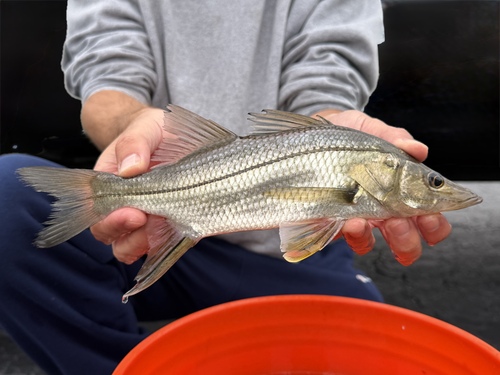
Swordspine Snook
Centropomus ensiferus
The most compact member of the snook family, the Swordspine Snook is recognized by its namesake blade-like spine and shimmering silver scales. A master of the mangroves, it is a frequent visitor to backyard docks and coastal canals across the Americas.
Quick Identification
Size
15-25 cm (6-10 in) typically, with a maximum length of 36 cm (14 in); weighs up to 0.5 kg (1.1 lbs)
Colors
Brilliant silver to brassy-yellow body with a prominent black lateral line; fins often show a distinct yellowish or orange tint.
Key Features
- Extremely long second anal spine that often reaches the tail base
- Deepest body profile of all snook species
- Large, conspicuous scales
- Dark lateral line extending onto the caudal fin
When You’ll See Them
Geographic range
Where Does the Swordspine Snook Live?
The Swordspine Snook is native to the warm tropical and subtropical waters of the Western Atlantic. Its range begins in southern Florida and extends through the Gulf of Mexico, encompassing the entire Caribbean coastline and the West Indies. This species is commonly found as far south as the Atlantic coast of Brazil, thriving anywhere that offers a mix of saltwater and freshwater access.
Basemap © OpenStreetMap contributors
Behavior
This species is notably more social than the Common Snook, frequently seen in small groups patrolling the edges of sea walls. They are sensitive to water temperature and will move into deeper, more stable waters or spring-fed rivers during cold snaps. In residential canal systems, they have adapted well to human presence, often using dock lights as hunting grounds after the sun goes down.
EverydayEarth exclusive
Camera Tips
Nighttime is the best opportunity for high-quality footage. Use a submersible green LED light to create a 'hunting zone' in front of your camera. The light attracts zooplankton, which draws in shrimp and small fish—the primary diet of the Swordspine Snook. Position your camera at the edge of the light's radius rather than directly in the center to capture the fish as they dart in from the darkness to strike.
Because Swordspine Snook are the smallest of the snook family, ensure your camera's motion sensitivity is set to high. Their movements can be very subtle as they drift with the tide. High-speed video recording (60fps) is highly recommended, as their feeding strike is one of the fastest movements in the animal kingdom and can appear as a mere blur on standard 30fps settings. Keep the lens clear of biofouling by wiping it weekly, especially in warm, nutrient-rich backyard canals.
Similar Species
Species that look similar or are commonly confused with Swordspine Snook.
Frequently Asked Questions
Record Swordspine Snook at your habitat
Connect a camera to start building your own species record — AI identifies every visitor automatically.