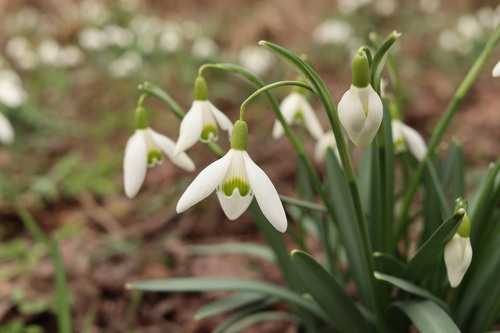
common snowdrop
Galanthus nivalis
The ultimate symbol of hope, the common snowdrop is the first flower to brave the winter chill, often carpeting garden floors in brilliant white before the first thaw.
Quick Identification
Size
7–15 cm (3–6 in) in height; flowers 15–25 mm (0.6–1 in) long
Colors
Pure white outer petals; inner petals are shorter with a green inverted 'U' or heart-shaped marking near the tip; foliage is a glaucous grey-green.
Key Features
- Three long, spreading outer tepals and three shorter inner tepals
- Nodding, bell-shaped flower head hanging from a slender pedicel
- Narrow, linear grey-green leaves emerging from the base
- Blooms in late winter, often pushing through snow
When You’ll See Them
Geographic range
Where Does the common snowdrop Live?
Native to a broad swathe of Europe, the common snowdrop’s natural range extends from the Pyrenees in the west, through Central Europe and Italy, to the Caucasus and Ukraine in the east. It has been widely naturalized across the United Kingdom, where it is often perceived as a native species despite being introduced centuries ago. In North America, it has successfully established populations in the Northeast and Pacific Northwest, thriving in temperate zones where winter chill triggers its annual growth cycle.
Basemap © OpenStreetMap contributors
Behavior
Common snowdrops are true harbingers of spring, known for their extreme cold tolerance and ability to bloom while the ground is still frozen. They emerge from small underground bulbs, utilizing a specialized 'hardened' leaf tip to pierce through crusty snow and ice. This early emergence allows them to take advantage of the full sunlight reaching the forest floor before deciduous trees leaf out and create shade.
The flowers exhibit a behavior called thermonasty: the petals open in response to warmth and close when temperatures drop, protecting the delicate reproductive organs inside. While they can spread via seeds dispersed by ants (which are attracted to a fatty treat on the seed called an elaiosome), snowdrops most commonly expand their presence through 'bulb splitting,' eventually creating the dense, white floral carpets for which they are famous.
EverydayEarth exclusive
Camera Tips
Capturing snowdrops on a backyard camera requires a different strategy than mobile wildlife. Because they are stationary, the best use of a trail camera is time-lapse mode. Set your camera to take a photo every 30 to 60 minutes. This allows you to witness the 'miracle' of the plant pushing through frozen soil and the dramatic opening and closing of the petals in response to the sun.
For the best perspective, mount your camera just a few inches off the ground using a ground spike or a small block. An 'ant’s-eye view' looking slightly up at the nodding bells creates a much more powerful image than looking down from above. If your camera allows for macro settings or has a close-focusing distance, use it—snowdrops are small, and you’ll want to see the delicate green markings on the inner petals.
Be mindful of the background. Since snowdrops are bright white, they can easily 'blow out' and lose detail in direct sunlight. Position your camera so the flowers are backed by dark soil, leaf litter, or evergreen foliage to make the white bells pop. If your camera has an exposure setting, try dialing it down by -1.0 to ensure the texture of the white petals is preserved.
Similar Species
Species that look similar or are commonly confused with common snowdrop.
Frequently Asked Questions
Record common snowdrop at your habitat
Connect a camera to start building your own species record — AI identifies every visitor automatically.