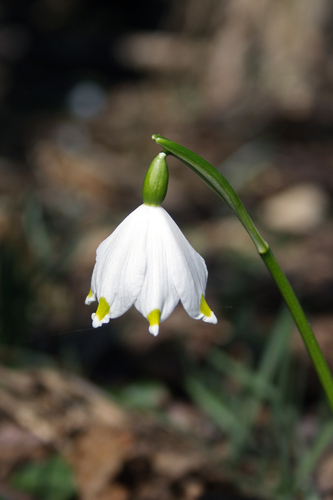
Spring Snowflake
Leucojum vernum
Emerging through the late winter frost, the Spring Snowflake is one of the earliest signs that warmer days are ahead. With its delicate white bells and characteristic green-tipped petals, it’s a favorite for backyard observers and early pollinators alike.
Quick Identification
Size
Stands 10–20 cm (4–8 inches) tall; flowers are approximately 2–3 cm (0.75–1.2 inches) wide.
Colors
Pure white tepals featuring a distinct lime-green or yellowish-green spot near the pointed tip; deep green, strap-shaped leaves.
Key Features
- Drooping, bell-shaped white flowers
- Six identical tepals each tipped with a green mark
- Narrow, dark green basal leaves
- Usually one flower per stalk (rarely two)
When You’ll See Them
Behavior
Spring Snowflakes are hardy early-bloomers that often appear while snow is still on the ground, signaling the transition from winter to spring. Unlike many other garden plants, they thrive in damp, cool conditions and are known for their nodding, bell-like posture which protects their pollen from early spring rains.
As a perennial bulb, the plant spends most of the year dormant underground, storing energy in its bulb for a brief but spectacular display in late February or March. They are social plants in a botanical sense, quickly naturalizing to form dense, shimmering white carpets in favorable environments like damp woodland floors or garden borders.
EverydayEarth exclusive
Camera Tips
Capturing the Spring Snowflake requires a low-profile approach. Because these plants only reach a few inches in height, mount your AI-powered camera on a ground stake or a very low tripod, positioning the lens roughly 5–8 inches from the ground. Aim for a side-on profile to capture the iconic 'bell' shape and the green markings at the tips of the tepals, rather than a top-down view which often hides the flower's character and prevents the AI from recognizing the drooping bloom.
For the most dramatic results, use the time-lapse feature on your camera. Set the interval to capture one photo every hour starting in late February. This will allow you to see the remarkable process of the flower stalk 'hooking' over and the petals unfurling. If your camera has a macro or 'close-focus' mode, ensure it is enabled to catch the fine details of the green spots and the delicate texture of the white tepals. Ensure you clear away any dead brown leaves or tall grass from the immediate foreground to keep the autofocus locked on the flower itself.
Don't just look for the plant itself—watch for interactions. Even in the cold of early March, these flowers are a vital food source for the first emerging bumblebee queens and hoverflies. Place your camera on the sunny side of the flower clump to catch these pollinators in the best light. Avoid using heavy lures or baits that might crush the delicate foliage; instead, ensure the soil around the plant is kept moist to keep the blooms looking turgid and healthy for the camera lens throughout their two-week blooming window.
Similar Species
Species that look similar or are commonly confused with Spring Snowflake.
Frequently Asked Questions
Record Spring Snowflake at your habitat
Connect a camera to start building your own species record — AI identifies every visitor automatically.