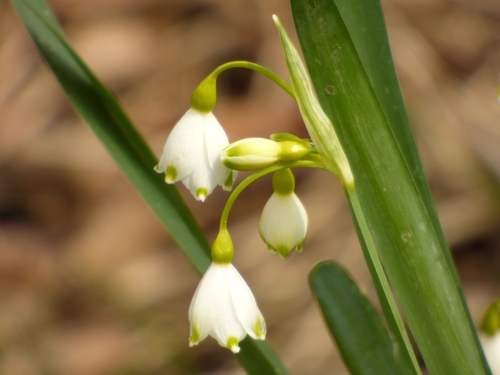
Summer snowflake
Leucojum aestivum
Graceful and resilient, the Summer snowflake dances in the spring breeze with its characteristic green-tipped bells. This moisture-loving beauty is the perfect subject for low-angle photography and a favorite stop for early-season pollinators.
Quick Identification
Size
Stems reach 30–60 cm (12–24 inches) in height; individual flowers are approximately 2 cm (0.75 inches) wide.
Colors
Brilliant white bell-shaped petals, each featuring a distinct emerald-green spot at the tip; foliage is a deep, glossy green.
Key Features
- Nodding, bell-shaped flowers hanging from a single hollow stem
- Distinctive green dot at the tip of each of the six tepals
- Strap-like, dark green leaves resembling daffodil foliage
- Clusters of 2 to 7 flowers per stalk rather than a single bloom
When You’ll See Them
Behavior
The Summer snowflake is a long-lived perennial bulb that specializes in naturalizing, meaning it will gradually spread to form impressive, dense clumps over several years. Despite its common name, it actually begins its display in mid-to-late spring, serving as a graceful transition between early spring ephemerals and summer perennials. The flowers are pendulous, nodding downward to protect their pollen from spring rain showers.
In a garden or backyard setting, these plants are remarkably self-sufficient. They are noted for their 'unpalatability' to common garden visitors like deer and rabbits, who tend to avoid them due to the bitter alkaloids contained in the leaves and bulbs. This makes them an excellent choice for unfenced wildlife gardens. They interact beautifully with the local ecosystem, providing an important nectar source for early-season bees and hoverflies.
EverydayEarth exclusive
Camera Tips
To truly capture the elegance of the Summer snowflake, mount your camera on a low-profile stake or ground mount. Aim for a height of about 8 to 12 inches, angling the lens slightly upward. This 'under-the-bell' perspective is crucial for capturing the signature green-tipped markings and the delicate internal structure of the flower that are often missed from a standing height.
Because the petals are a bright, reflective white, they are prone to overexposure in direct midday sun, which can turn your photos into featureless white blobs. Set your camera to capture images during the 'Golden Hours' of early morning or late afternoon. If your camera allows for exposure compensation, dialing it down by -0.5 or -1.0 can help preserve the fine texture of the white tepals and the vibrant green spots.
For those using AI-powered cameras to track backyard visitors, Summer snowflakes are excellent 'pollinator hubs.' Position your camera about 2 feet away from a large clump and use a high-speed trigger setting. This will allow you to capture the various species of bees and flies that crawl inside the bells. If you are using a trail camera with time-lapse capabilities, set it to take one photo every hour during the spring growth spurt to watch the stems 'race' toward the sun.
Lastly, keep in mind that these plants love moisture. If you are placing your camera in the damp, boggy soil where Summer snowflakes thrive, ensure your equipment is well-protected from rising ground moisture. A small piece of slate or a wooden shingle placed under the camera can prevent it from sinking or becoming fouled by mud during spring rainstorms.
Similar Species
Species that look similar or are commonly confused with Summer snowflake.
Frequently Asked Questions
Record Summer snowflake at your habitat
Connect a camera to start building your own species record — AI identifies every visitor automatically.