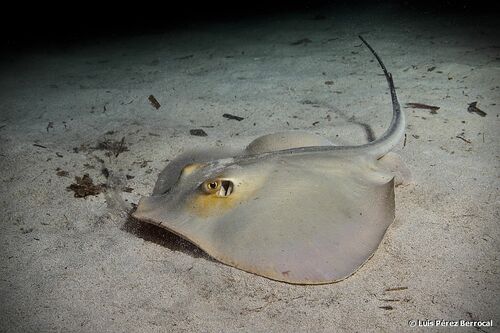
Common Stingray
Dasyatis pastinaca
A silent glider of the sandy shallows, the Common Stingray blends perfectly into the seafloor of the Atlantic and Mediterranean. Known for its elegant diamond shape and whip-like tail, this ray is a fascinating predator of the coastal shelf.
Quick Identification
Size
Disc width typically 45 cm (18 in); total length up to 1.4 m (4.6 ft); weights reach 10 kg (22 lbs)
Colors
Uniform olive-brown, grey, or yellowish topside with dark margins; underside is cream or white
Key Features
- Diamond-shaped pectoral disc slightly wider than long
- Whip-like tail with a venomous serrated spine
- Smooth skin without thorns (except for small midline tubercles in large adults)
- Distinct upper and lower fin folds on the tail
When You’ll See Them
Geographic range
Where Does the Common Stingray Live?
The Common Stingray is native to the temperate and subtropical waters of the northeastern Atlantic Ocean, ranging from the southern coasts of Norway and the British Isles down to the Canary Islands and the western coast of Africa. It is a defining species of the Mediterranean and Black Seas, where it thrives in the warm, shallow coastal shelf environments. While it does not have introduced populations, its range is closely tied to sandy-bottomed coastal zones where water depths remain under 60 metres.
Basemap © OpenStreetMap contributors
Behavior
The Common Stingray is a master of camouflage, often spending much of its day partially buried in the sand or mud of the seafloor. It uses its pectoral fins to wave sediment over its back, leaving only its eyes and spiracles (breathing holes) exposed to detect passing predators or prey. While largely solitary, they are known to gather in larger groups during the summer months for mating or seasonal migrations to deeper water.
These rays are generally docile and will glide away if they sense a human approaching. However, they possess a formidable venomous spine at the base of their tail used purely for defense. In coastal areas popular with swimmers, they can be a hazard if stepped on, as the ray will reflexively whip its tail upward. They are highly intelligent foragers, using electroreception to sense the tiny electrical pulses emitted by hidden prey beneath the sand.
EverydayEarth exclusive
Camera Tips
Capturing a Common Stingray on camera requires specialized underwater equipment, as they inhabit the subtidal zone. If you have a coastal property or access to a pier, use an action camera with a high-quality waterproof housing. Because these rays live in high-energy environments with moving tides, you must secure your camera to a weighted base—a 'sea sled' made of lead weights or a heavy diving belt works well to keep the lens stable on the sandy floor.
For the best chance of a 'backyard' sighting, place your camera near transition zones, such as the edge of a seagrass meadow or a rocky reef where the ray might search for crustaceans. To lure them into the frame, use a mesh 'scent bag' filled with oily fish guts, crushed squid, or shrimp. Anchor the bait bag about 2 to 3 feet in front of the lens. The ray's sensitive electroreceptors and sense of smell will lead it directly to the camera, often resulting in spectacular close-ups of their underside as they pass over the bait.
Since Common Stingrays are most active during the twilight hours of dawn and dusk, lighting is your biggest challenge. If your camera setup allows, use an external red light source; rays are less sensitive to red spectrum light, making them less likely to be spooked. Set your camera to a high frame rate (60fps or higher) to capture the fluid, undulating motion of their pectoral fins. In murky water, keep the camera as close to the bait as possible to minimize the 'backscatter' effect of particles in the water column.
Similar Species
Species that look similar or are commonly confused with Common Stingray.
Frequently Asked Questions
Record Common Stingray at your habitat
Connect a camera to start building your own species record — AI identifies every visitor automatically.