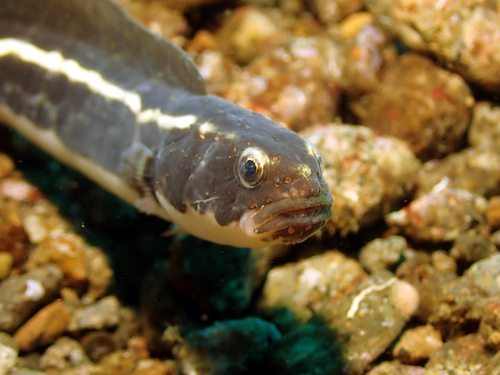
Convict Blenny
Pholidichthys leucotaenia
The ultimate architect of the reef, the Convict Blenny builds vast underground cities and exhibits some of the most unique parental care in the ocean.
Quick Identification
Size
Adults typically reach 25–34 cm (10–13.4 inches) in length.
Colors
Juveniles are black with a bright white horizontal stripe. Adults transition to a dark body with intricate, maze-like yellow or white reticulated patterns.
Key Features
- Elongated, eel-like body shape
- Juveniles mimic the appearance of venomous catfish
- Adults feature a complex 'marbled' or reticulated skin pattern
- Continuous dorsal and anal fins joined to the caudal fin
- Strongly protruding eyes used for monitoring burrow entrances
When You’ll See Them
Geographic range
Where Does the Convict Blenny Live?
The Convict Blenny is a signature species of the tropical West-Central Pacific Ocean. Its range is centered within the Coral Triangle, with high population densities found throughout the Philippines, Indonesia, and the Solomon Islands. They are also frequently documented along the northern reaches of the Great Barrier Reef in Australia and the coastal waters of Papua New Guinea. This species is strictly marine and is not found in freshwater or introduced populations outside its native tropical range.
Basemap © OpenStreetMap contributors
Behavior
Their social behavior is truly remarkable and rare among fish. While the adults remain in the security of the burrow, the juveniles emerge in massive, coordinated swarms to feed on plankton during the day. At night, the young return to the burrow, where they hang from the ceiling by mucous threads. Fascinatingly, the adults are believed to be fed by their offspring, either through the young regurgitating food or by the adults consuming the nutrient-rich mucus produced by the juveniles.
EverydayEarth exclusive
Camera Tips
To capture high-quality footage of a Convict Blenny, you will need an underwater camera setup or a waterproof action camera mounted on a stable weighted base. Look for tell-tale signs of their 'engineering' work: small craters in the sand or piles of coral rubble near a hole. Position your camera about 12 to 18 inches away from a burrow entrance, keeping the lens at a low, horizontal angle to catch the adults as they poke their heads out to spit out sand. Using a camera with a wide-angle lens is ideal for capturing the scale of their excavation sites.
If you are looking for the striking juvenile swarms, aim your camera upward from the seabed toward the light. Juveniles hover in a vertical orientation, looking like a curtain of stripes. For the best visual results, record during the late morning when the sun is directly overhead; this provides maximum natural light to penetrate the water and highlight the white stripes of the young fish. Setting your camera to 60 frames per second (fps) will help capture the fluid, eel-like swimming motion of the adults without motion blur.
For nighttime observation, use a camera with high ISO capabilities or a diffused red LED light. White lights often cause these shy fish to retreat deep into their tunnels, but they are less sensitive to red spectrum light. At night, you may be able to film the fascinating 'hanging' behavior of the juveniles or catch a rare glimpse of an adult performing heavy maintenance on the burrow entrance. Ensure your camera housing is thoroughly rinsed with fresh water after every deployment to prevent salt crystals from damaging the seals.
Similar Species
Species that look similar or are commonly confused with Convict Blenny.
Frequently Asked Questions
Record Convict Blenny at your habitat
Connect a camera to start building your own species record — AI identifies every visitor automatically.