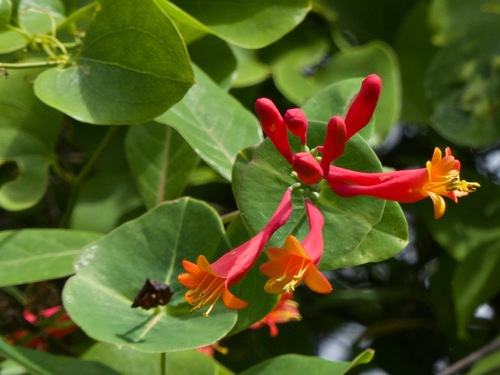
coral honeysuckle
Lonicera sempervirens
A spectacular native climber, coral honeysuckle is the crown jewel of the hummingbird garden. Its scarlet trumpets and lush green foliage provide a vital nectar highway for pollinators across North America.
Quick Identification
Size
Vine growing 3 to 6 meters (10 to 20 feet) long; flowers 3 to 5 cm (1 to 2 inches) in length.
Colors
Tubular coral-red to scarlet flowers with bright yellow interiors; glossy dark green foliage with silver-grey undersides.
Key Features
- Clusters of trumpet-shaped reddish flowers
- Upper pair of leaves fused into a circular disk (perfoliate)
- Bright red berries produced in autumn
- Non-twining woody stems with papery, peeling bark
When You’ll See Them
Geographic range
Where Does the coral honeysuckle Live?
This vibrant vine is native to the North American continent, primarily spanning the eastern and central regions of the United States. Its natural range extends from the coastal forests of Connecticut and New York southward to the tip of Florida, and stretches westward across the Deep South into East Texas and Oklahoma. While it thrives in the humid subtropical climates of the Southeast, it has also become a staple in temperate gardens across the Midwest and Mid-Atlantic due to its cold hardiness.
Basemap © OpenStreetMap contributors
Behavior
Coral honeysuckle is a high-climbing, woody perennial vine that is celebrated for its spectacular spring and summer blooms. Unlike its invasive relative, the Japanese honeysuckle, this native species is non-aggressive and does not choke out neighboring trees. It uses its slender stems to scramble over fences, trellises, or through the canopy of small shrubs, providing excellent vertical structure in a wildlife garden.
This plant is biologically programmed to attract hummingbirds, particularly the Ruby-throated Hummingbird, which serves as its primary pollinator. The long, tubular flowers are perfectly shaped for the hummingbird's bill. In addition to nectar, the plant provides significant value in the late season by producing translucent red berries that serve as a high-energy food source for migrating songbirds and overwintering residents.
EverydayEarth exclusive
Camera Tips
To capture the most exciting action around your coral honeysuckle, position your camera approximately 3 to 5 feet away from a dense cluster of open flowers. Because the primary visitors are hummingbirds, you will need a camera with a fast trigger speed or, ideally, a high-definition video mode. Aim the camera slightly upward to catch the underside of the flowers and the throat of the bird as it hovers to feed.
Lighting is critical for making the coral-red petals pop. Try to place your camera with the sun at its back (facing north or south) to avoid silhouette effects or lens flare during the morning and evening hours when hummingbirds are most active. If your AI camera has a 'pet' or 'bird' detection mode, ensure it is enabled to catch the rapid movement of the pollinators.
Don't stop filming once the flowers fade. During the autumn months, re-adjust your camera angle toward the maturing red berries. This is the best time to capture footage of songbirds like Gray Catbirds, Northern Cardinals, and Hermit Thrushes. A side-profile view of the vine against a neutral background like a fence or wall will help your AI correctly identify the birds as they land to forage.
Similar Species
Species that look similar or are commonly confused with coral honeysuckle.
Frequently Asked Questions
Record coral honeysuckle at your habitat
Connect a camera to start building your own species record — AI identifies every visitor automatically.