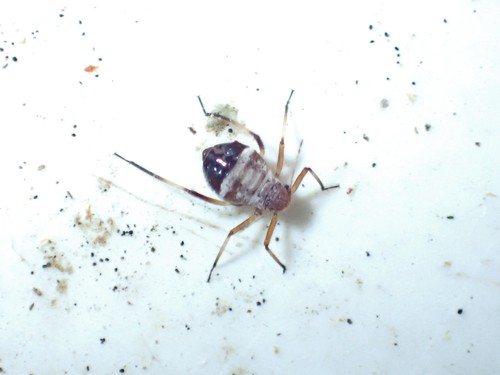
Corsican Pine Shoot Aphid
Cinara brauni
A giant among aphids, the Corsican Pine Shoot Aphid is a master of the pine canopy. Watch closely and you'll see a miniature world of ant 'shepherds' and sugary rewards unfolding on the branches of Black pines.
Quick Identification
Size
3.5 to 5.2 mm (0.14 to 0.20 inches) in length
Colors
Deep reddish-brown to blackish body; often features a light dusting of greyish-white wax on the underside
Key Features
- Large, pear-shaped body for an aphid
- Specialist on Pinus nigra (Corsican/Black Pine)
- Wide, cone-shaped, hairy siphunculi (tail pipes)
- Long, spindly legs often darker than the body
When You’ll See Them
Geographic range
Where Does the Corsican Pine Shoot Aphid Live?
Native to Southern and Central Europe, the Corsican Pine Shoot Aphid follows the natural distribution of the Black Pine across the Mediterranean and Alpine regions. It has expanded its range significantly into Northern Europe and the United Kingdom, where its host trees are popular for forestry. Introduced populations are also occasionally noted in temperate parts of North America and other regions where Corsican pines are used in landscaping.
Basemap © OpenStreetMap contributors
Behavior
The Corsican Pine Shoot Aphid is a gregarious species, often found in dense, bustling colonies on the young shoots and twigs of its host tree. Unlike many smaller garden aphids that hide under leaves, these 'giant conifer aphids' are quite bold, congregating directly on the bark of the previous year's growth or the base of new shoots. They spend the majority of their time stationary, with their long, needle-like mouthparts inserted into the tree to feed on nutrient-rich sap.
This species is highly 'trophobiotic,' meaning it maintains a complex relationship with ants. Ants are almost always found patrolling the aphid colonies, acting as bodyguards against predators like ladybugs and hoverfly larvae. In exchange for this protection, the aphids provide the ants with honeydew—a sugary waste product. If you see a line of ants climbing a pine tree, they are almost certainly heading toward a Cinara brauni colony.
EverydayEarth exclusive
Camera Tips
Capturing the Corsican Pine Shoot Aphid requires a specialized approach because of their small size. A standard trail camera will likely struggle with focus; instead, use a camera with a dedicated macro lens or a high-quality smartphone with a macro attachment. Mount your camera directly to a sturdy branch of a Corsican or Black Pine. Focus your lens on the area where the green needles meet the woody stem, as this is the aphids' preferred feeding site.
Lighting is the most critical factor for insect photography. Because pine canopies can be quite dark, use a small, portable LED panel to provide fill light. This will help highlight the fine hairs on the aphid's body and the shimmering honeydew droplets. If you are using a triggered setup, set the PIR sensitivity to high, though it is often better to use a time-lapse setting (one photo every 30 seconds) to capture the interaction between the aphids and their attendant ants.
Look for signs of activity before placing your camera. Sticky needles coated in honeydew or the presence of 'sooty mold' (a black fungus) are clear indicators that a colony is active nearby. The best time for filming is in late spring when the populations are most dense and the winged 'alates' begin to appear, adding more visual interest to the colony's dynamics.
Similar Species
Species that look similar or are commonly confused with Corsican Pine Shoot Aphid.
Frequently Asked Questions
Record Corsican Pine Shoot Aphid at your habitat
Connect a camera to start building your own species record — AI identifies every visitor automatically.