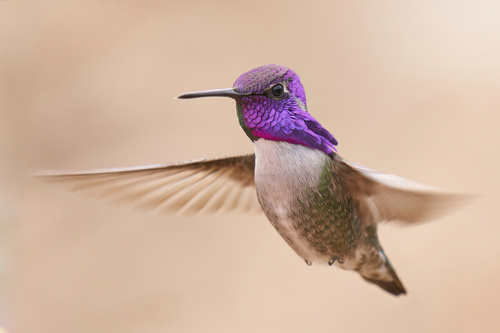
Costa's Hummingbird
Calypte costae
A tiny desert jewel with a regal purple crown, the Costa's Hummingbird is the Southwestern desert's most dazzling aerial acrobat.
Quick Identification
Size
7.5–9 cm (3–3.5 in) long, 11 cm (4.3 in) wingspan, weighing approximately 2.5–3.5 g (0.1 oz)
Colors
Males have a brilliant iridescent violet-purple crown and gorget (throat) that extends into long 'mustache' flares; females have grayish-green backs and white underparts.
Key Features
- Iridescent violet crown and elongated throat feathers on males
- Short tail that barely reaches the wingtips at rest
- Small, hunchbacked posture compared to other hummingbirds
- High-pitched, thin whistling sound during flight and dives
When You’ll See Them
Geographic range
Where Does the Costa's Hummingbird Live?
Native to the North American continent, the Costa's Hummingbird is a true specialist of the arid Southwest. Its core range spans from Southern California, Southern Nevada, and Southwest Utah through Arizona and down into the Baja California Peninsula and northwestern Mexico. While many populations are migratory, moving toward the coast or further south into Mexico for the winter, some residents can be found year-round in the warmer coastal sage scrubs of California.
Basemap © OpenStreetMap contributors
Behavior
Unlike some of their more aggressive relatives, Costa’s tend to be slightly more elusive and less dominant at multi-species feeders, often preferring to zip in and out quickly. They are remarkably agile flyers, capable of hovering with precision while feeding on delicate desert blooms. In backyard settings, they are often seen as 'the early birds' of the spring, arriving in desert gardens to breed just as the first wildflowers begin to bloom.
EverydayEarth exclusive
Camera Tips
Lighting is the most important factor for this species. The male's brilliant purple gorget is a structural color, meaning it only appears vibrant when the light hits it at a specific angle. For the best results, position your camera facing away from the sun—aiming North or East in the early morning—so the bird is front-lit. This increases the chances of the camera catching the metallic flash when the bird turns its head toward the lens.
If you want to capture unique behaviors, focus on water. Costa's Hummingbirds are drawn to fine misters and shallow, moving water features in dry climates. Placing a camera near a 'bubbler' fountain or a misting attachment can result in incredible footage of them bathing. Additionally, look for a favorite 'sentry perch'—usually a bare, thin twig near a food source. Once you identify a branch they regularly sit on to survey their territory, aim your camera there for the most detailed, still portraits.
Similar Species
Species that look similar or are commonly confused with Costa's Hummingbird.
Anna's Hummingbird
Slightly larger with a rose-red gorget rather than violet; the Anna's gorget lacks the long, flared side feathers seen on the Costa's.
Black-chinned Hummingbird
Features a much thinner strip of purple at the base of a black throat, and lacks the iridescent purple crown found on the Costa's.
Frequently Asked Questions
Record Costa's Hummingbird at your habitat
Connect a camera to start building your own species record — AI identifies every visitor automatically.