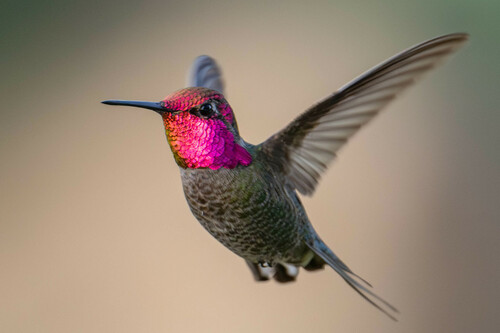
Anna's Hummingbird
Calypte anna
The boldest jewel of the Pacific Coast, Anna's Hummingbirds are year-round garden residents known for their dazzling rose-pink crowns and fearless personalities.
Quick Identification
Size
Length: 3.9–4.3 in (10 cm); Wingspan: 4.7 in (12 cm); Weight: 0.1–0.2 oz (3–6 g)
Colors
Iridescent bronze-green back; males have a brilliant rose-pink crown and throat (gorget); females have a green crown and greyish throat with small red spots.
Key Features
- Iridescent rose-pink crown and throat on males
- Stocky, medium-sized build for a hummingbird
- Metallic green plumage with greyish underparts
- Straight, black needle-like bill
When You’ll See Them
Sightings on EverydayEarth
Mar 31, 2026
An adult hummingbird is seen tending to its nest, carefully feeding two tiny nestlings whose orange-lined mouths are briefly visible. After feeding, the adult bird shimmies and flutters its wings to settle comfortably into the nest to brood the young.
Mar 30, 2026
An Anna's Hummingbird is nestled comfortably in her small, cup-shaped nest built among leafy branches. She is alert, frequently blinking and turning her head to monitor the surrounding environment while maintaining her position on the nest.
May 14, 2026
An adult male Anna's Hummingbird perches on the rim of a red nectar feeder, taking several drinks before departing. The iridescent magenta plumage on its head and throat is clearly visible in the daylight against the backdrop of dry brush.
Apr 27, 2026
A hummingbird sits alertly in its small, cup-shaped nest, which is camouflaged with lichen and spider silk. The bird frequently scans its surroundings by turning its head and blinking, occasionally shifting its position within the nest. A small insect is briefly visible crawling on the branch to the right of the nest.
Apr 26, 2026
An Anna's Hummingbird is seen sitting calmly in its small, cup-shaped nest built from plant fibers and spider silk. The bird stays mostly still, though it occasionally turns its head to observe the environment.
Apr 26, 2026
An Anna's Hummingbird briefly visits the nest, landing on the rim and looking around before quickly taking flight and exiting the frame.
Geographic range
Where Does the Anna's Hummingbird Live?
Native to the Pacific Coast of North America, the Anna's Hummingbird is found from southern British Columbia down through California and into northern Baja California. While once restricted to a smaller range in southern California, they have expanded dramatically northward and eastward into Arizona over the last century. This expansion is largely attributed to the widespread planting of exotic flowering trees and the consistent availability of backyard nectar feeders in residential areas.
Basemap © OpenStreetMap contributors
Recorded on EverydayEarth
Behavior
Anna's Hummingbirds are famously bold and territorial garden residents. Unlike many other hummingbird species that migrate long distances during the winter, Anna's are often year-round residents in their range, especially where backyard feeders are present. They are highly active during the day, spending much of their time defending nectar-rich territories from other hummingbirds and even larger birds or insects.
The males are known for their spectacular courtship displays, which include soaring up to 130 feet in the air and then diving toward the ground at high speeds. At the bottom of the dive, they produce a sharp, metallic 'pop' sound with their tail feathers. They are remarkably comfortable around humans and will often hover just inches away from people to investigate bright clothing or flowers.
EverydayEarth exclusive
Camera Tips
To capture the stunning iridescence of an Anna's Hummingbird, camera placement is critical. Position your AI-powered camera within 18 to 24 inches of a nectar feeder or a cluster of favorite flowers like Salvia, Fuchsia, or Hummingbird Sage. Because these birds move with incredible speed, ensure your camera is set to its highest shutter speed or 'action' mode to prevent motion blur during wing beats.
Lighting is the 'secret sauce' for hummingbird photography. Aim your lens so the sun is behind or to the side of the camera. The brilliant rose-pink color on the male's head is structural, not pigment-based, meaning it only 'flashes' when the light hits it at a specific angle. If the bird looks black or dull on camera, try adjusting the angle of your feeder or camera relative to the sun.
Look for a 'sentinel perch'—a small, bare twig near a food source where the bird likes to rest between feeds. Placing a camera with a view of this perch can capture beautiful, still shots of the bird scanning its territory. In winter, Anna's are often the only hummingbirds present in the Pacific Northwest and California, making them a reliable subject when other migratory species have headed south. Keep your feeders clean and thawed during cold snaps to keep them coming back to your lens.
Similar Species
Species that look similar or are commonly confused with Anna's Hummingbird.
Costa's Hummingbird
Costa's have a deep purple gorget with long 'flares' on the sides, while Anna's have a rose-pink gorget that is more rounded.
Black-chinned Hummingbird
Black-chinned males have a dark throat with a thin violet band at the bottom, lacking the full pink crown of the Anna's.
Rufous Hummingbird
Rufous hummingbirds have distinct copper-orange or cinnamon coloring on their backs and bellies, which Anna's lack.
Frequently Asked Questions
Record Anna's Hummingbird at your habitat
Connect a camera to start building your own species record — AI identifies every visitor automatically.