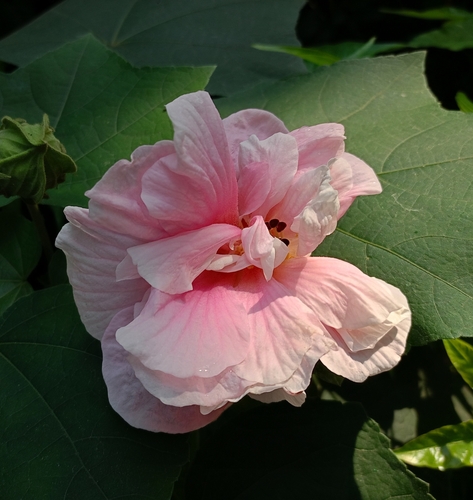
Cotton Rosemallow
Hibiscus mutabilis
Witness the 'Confederate Rose,' a botanical marvel that transforms from snowy white to ruby red in the span of a single sun-drenched day.
Quick Identification
Size
A large shrub or small tree reaching 6–15 feet (1.8–4.6 m) in height with a spread of 6–10 feet (1.8–3 m).
Colors
Flowers emerge white or light pink in the morning, deepening to a rose or dark red by evening; leaves are a vibrant, dull green.
Key Features
- Flowers that change color from white to deep pink in a single day
- Large, heart-shaped leaves with 5-7 palmately lobes
- Stems and undersides of leaves covered in soft, fuzzy hairs (pubescence)
- Large, showy blossoms measuring 4-6 inches across
When You’ll See Them
Geographic range
Where Does the Cotton Rosemallow Live?
The Cotton Rosemallow is native to the warm, subtropical regions of Southern China and Taiwan, where it has been cultivated for centuries. From its East Asian roots, it has spread across the globe and is now a staple in the landscapes of the Southeastern United States—where it is affectionately known as the Confederate Rose—as well as throughout South America, Africa, and Southern Europe. It thrives in USDA zones 7 through 11, finding a home anywhere the winters are relatively mild and the summers provide ample humidity.
Basemap © OpenStreetMap contributors
Behavior
The Cotton Rosemallow is a perennial deciduous shrub celebrated for its dramatic diurnal flower transformation. In the morning, blossoms open as a pure, snowy white or pale pink. As the day progresses and the temperature rises, chemical changes within the petals cause them to darken, ending the day as a deep magenta or crimson. This rapid color shift is one of the most striking visual displays in the botanical world.
Beyond its visual appeal, the plant acts as a vital hub for backyard biodiversity. Its late-season blooming period, typically from late summer into autumn, provides a critical nectar source for pollinators when many other flowers have faded. While it is a vigorous grower that can reach the size of a small tree in a single season, it remains relatively low-maintenance, though it will drop its large leaves and go dormant after the first hard frost in temperate zones.
EverydayEarth exclusive
Camera Tips
To truly capture the magic of the Cotton Rosemallow, you must use your camera’s time-lapse feature. Set your camera on a sturdy tripod or a secure mount facing a single, healthy bud that looks ready to open at dawn. Program the camera to take a photo every 15 to 30 minutes from 7:00 AM until sunset. When stitched together, this reveals the incredible 'mutabilis' (changing) nature of the plant as the white flower blushes into deep red before your eyes.
For those interested in wildlife photography, these flowers are magnets for hummingbirds and large butterflies like Swallowtails. Place your camera approximately 3 to 5 feet from a cluster of active blooms, ideally at a slightly upward angle to catch the pollinators as they hover near the central stamen. Use a fast shutter speed or a 'burst mode' triggered by motion to freeze the rapid wingbeats of visitors.
Lighting is crucial for this species. Because the leaves are large and the flowers can be quite bright, high-noon sun can cause 'blown-out' highlights. Position your camera so the sun is behind or to the side of the plant to capture the translucent quality of the petals. If your camera allows for macro settings, try to get a close-up of the fuzzy seed pods that form after the flowers fall; they provide wonderful texture and interest even after the blooming season has ended.
Similar Species
Species that look similar or are commonly confused with Cotton Rosemallow.
Frequently Asked Questions
Record Cotton Rosemallow at your habitat
Connect a camera to start building your own species record — AI identifies every visitor automatically.