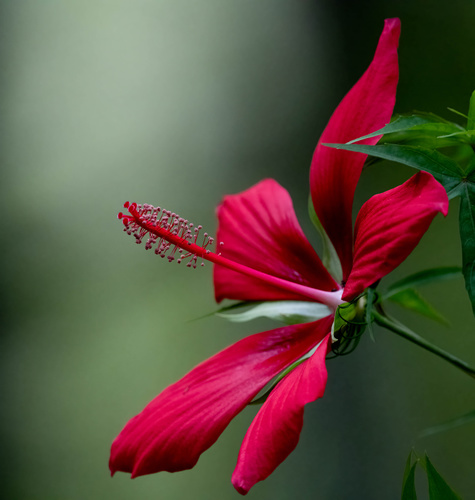
Scarlet Rosemallow
Hibiscus coccineus
A towering beacon of the American wetlands, the Scarlet Rosemallow commands attention with its massive, star-shaped crimson blooms and elegant, palmate foliage.
Quick Identification
Size
Stands 3–8 feet (0.9–2.4 m) tall with a spread of 2–4 feet (0.6–1.2 m)
Colors
Brilliant crimson or scarlet petals; deep green foliage; yellow-tipped central stamen column
Key Features
- Five large, separated scarlet petals forming a star shape
- Deeply lobed, palmate leaves resembling a star or hemp leaf
- Tall, slender woody-based stems
- Prominent central column of stamens and pistils
When You’ll See Them
Behavior
The Scarlet Rosemallow is a dramatic perennial known for its striking 'Texas Star' shape. Unlike many other hibiscus species with overlapping petals, this plant features five distinct, widely spaced petals that give it a sophisticated, airy appearance. It is a deciduous species, meaning it will die back completely to the ground after the first hard frost of winter, only to emerge rapidly from its rootstock in late spring once temperatures rise.
As a wetland native, its 'behavior' is dictated by water and light. It is a sun-worshipper that tracks the light throughout the day, with individual blossoms typically lasting only 24 hours. Despite the short life of a single flower, the plant produces a prolific succession of blooms over several weeks, acting as a high-traffic hub for long-tongued pollinators like hummingbirds and specialized bees that are drawn to its intense red hue.
EverydayEarth exclusive
Camera Tips
Capturing the Scarlet Rosemallow effectively requires a dual strategy: capturing the 'slow life' of the plant and the 'fast life' of its visitors. To capture the spectacular bloom cycle, set your camera to time-lapse mode. Because each flower lasts only a day, start your time-lapse at dawn. Position the camera at flower-height (usually 4–6 feet) and set an interval of one frame every 2 minutes. This will create a stunning sequence of the petals unfurling in the morning sun and folding back by dusk.
For wildlife enthusiasts, this plant is the ultimate 'bait' for hummingbirds and butterflies. Place your AI-powered camera on a tripod approximately 3–5 feet away from a cluster of active buds. Angle the lens slightly upward to catch the underside of the flower and the profile of visiting Ruby-throated Hummingbirds. High shutter speeds (at least 1/1000s) are essential if your camera allows manual overrides, as this will freeze the wing motion of the Palamedes Swallowtails and hummingbirds drawn to the deep nectar wells.
Placement is critical; avoid placing the camera in a spot where it will be shaded by the plant's own large leaves. Use the morning sun to your advantage by positioning the camera with the sun at your back, illuminating the translucent red petals. Because this plant loves water, ensure your equipment is protected from the high humidity or mud often found at the base of the stalks.
During the late season, don't move your camera immediately. The dried seed pods provide excellent architectural interest and attract small songbirds like goldfinches that may land on the stalks to investigate the dried remains. Keep your 'motion trigger' sensitivity high, as the swaying of the tall stalks in the wind can cause false triggers; try to frame the shot so the heaviest stalks are centered and less prone to edge-of-frame motion blur.
Similar Species
Species that look similar or are commonly confused with Scarlet Rosemallow.
Frequently Asked Questions
Record Scarlet Rosemallow at your habitat
Connect a camera to start building your own species record — AI identifies every visitor automatically.