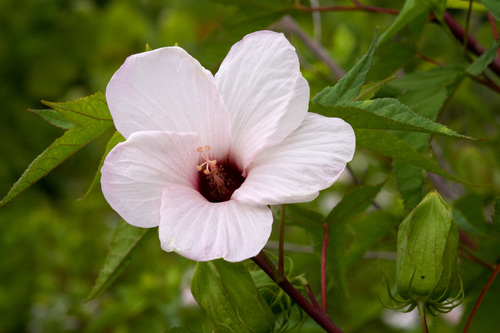
Halberd-leaf Rosemallow
Hibiscus laevis
A towering wetland beauty, the Halberd-leaf Rosemallow commands attention with its massive, tropical-looking blooms and unique spear-shaped foliage. This native hibiscus is a summer spectacle that brings a touch of the exotic to North American riverbanks.
Quick Identification
Size
Stems reach 3–6 feet (0.9–1.8 meters) tall; flowers are 4–6 inches (10–15 cm) in diameter.
Colors
Creamy white to pale pink petals with a deep maroon or crimson throat; foliage is a soft grayish-green.
Key Features
- Halberd-shaped leaves with two distinct pointed lobes at the base
- Large, funnel-shaped flowers with a dark red center
- Smooth, hairless stems (unlike other mallows)
- Blooms open for only 24 hours
When You’ll See Them
Behavior
The Halberd-leaf Rosemallow is a robust perennial that behaves like a sun-seeker, timed perfectly to the rhythms of the summer heat. Each flower is an ephemeral masterpiece, unfolding its massive petals as the morning sun hits the foliage and closing permanently by sunset. Because each bloom lasts only a single day, the plant produces a staggered succession of buds to ensure a long flowering season from mid-summer through early autumn.
In the wild, it acts as a critical anchor for wetland ecosystems. It has a specialized relationship with the Hibiscus Bee (Ptilothrix bombiformis), which relies almost exclusively on this genus for pollen. To the casual observer, the plant may look like a tropical escapee, but it is a hardy native that dies back to the ground each winter, only to emerge with vigorous growth once the soil warms in late spring.
EverydayEarth exclusive
Camera Tips
To capture the dramatic life cycle of the Halberd-leaf Rosemallow, time-lapse photography is your best tool. Set your camera to take a photo every 10 to 15 minutes starting just before sunrise. This allows you to document the incredible 'unfolding' of the petals, which happens with surprising speed as the temperature rises. Because the plant can reach six feet in height, use a tall tripod or a fence mount to position the camera slightly above the flower head, angled downward at 45 degrees to capture the deep crimson 'eye' of the bloom.
If you are looking to capture wildlife interactions, set your camera's trigger sensitivity to high and focus on the central stamen column. This is the landing pad for the Hibiscus Bee and various hummingbirds. Since these plants thrive in wet soil, ensure your equipment is stabilized on a firm patch of ground or use a platform to prevent the camera from shifting in the mud. For the best color saturation, aim for 'Golden Hour' shots in the morning; the soft side-lighting highlights the delicate, paper-like texture of the petals without washing out the pale colors.
Don't stop recording once the flower begins to wilt in the late afternoon. The 'closing' phase is just as interesting as the opening, as the petals twist into a tight spiral. If you are using a trail camera with video capabilities, 20-second clips triggered by movement will help you catch the rapid-fire visits of pollinators that frequent the plant during the peak heat of the day. Check your lens frequently for dew or water spots, as the humid environments these plants prefer can lead to foggy footage.
Similar Species
Species that look similar or are commonly confused with Halberd-leaf Rosemallow.
Swamp Rose Mallow
Has broader, heart-shaped leaves and velvety, hairy undersides on the foliage compared to the smooth, lobed leaves of the Halberd-leaf.
Scarlet Rosemallow
Features brilliant deep red flowers and deeply divided, finger-like leaves rather than the pale pink/white blooms and halberd-shaped leaves.
Frequently Asked Questions
Record Halberd-leaf Rosemallow at your habitat
Connect a camera to start building your own species record — AI identifies every visitor automatically.