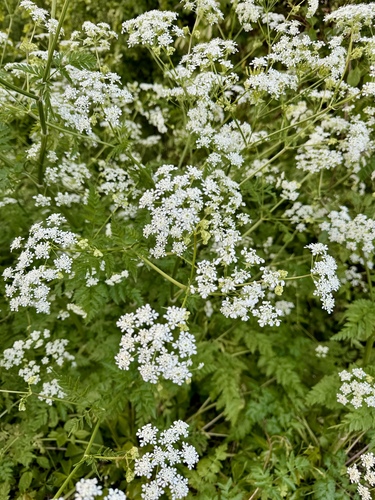
Cow Parsley
Anthriscus sylvestris
Known as the 'Queen of the Hedgerow,' Cow Parsley paints the spring landscape in frothy white lace. This hardy wildflower is a vital early-season sanctuary for pollinators and a beautiful indicator of the changing seasons.
Quick Identification
Size
60-170 cm (24-67 inches) in height with umbels 2-6 cm (0.8-2.4 inches) wide
Colors
Brilliant white flowers with bright green to deep green feathery foliage; stems are green, sometimes with a reddish-purple tint at the base
Key Features
- Large umbrella-like clusters of tiny white flowers
- Fern-like, tripinnate green leaves with a soft texture
- Hollow, furrowed stems that are slightly hairy
- Early blooming period starting in mid-spring
- Deep, fleshy taproot
When You’ll See Them
Geographic range
Where Does the Cow Parsley Live?
Native to the temperate regions of Europe, western Asia, and northwestern Africa, Cow Parsley is a quintessential feature of the Old World countryside. It is found in abundance from the British Isles across to the Balkans and into parts of Siberia. While it is native to these regions, it has been introduced to North America, where it is now widely naturalized across the northern United States and Canada, frequently appearing in damp meadows and along highway corridors.
Basemap © OpenStreetMap contributors
Behavior
Ecologically, Cow Parsley acts as a critical 'bridge' species for pollinators. Because it flowers as early as April, it provides an essential early-season nectar source for hoverflies, solitary bees, and beetles. Its structure, composed of many tiny flowers arranged in a flat-topped 'umbel,' allows insects with short mouthparts to easily access its sugars, making it a bustling hub of activity in the backyard ecosystem.
EverydayEarth exclusive
Camera Tips
Capturing Cow Parsley on a backyard camera is less about tracking the plant and more about documenting the vibrant micro-ecosystem it supports. To capture the insects that visit, set your camera on a macro or close-focus setting and mount it on a small tripod roughly 12 to 18 inches from the ground. Aiming your lens directly at a cluster of white umbels will allow you to record the fascinating behaviors of hoverflies and beetles that are otherwise too small to see from a distance.
For those looking to capture larger wildlife, Cow Parsley makes for an exceptional natural framing tool. Position your camera about 2 to 3 feet off the ground along a hedgerow where Cow Parsley is growing. The bright white flowers provide a high-contrast background that helps dark-furred animals like foxes, badgers, or black bears stand out in low-light conditions. Because the white petals reflect ambient light, they can even help illuminate a subject during the 'blue hour' of dusk without over-triggering your camera's infrared flash.
Time-lapse mode is perhaps the best way to showcase this species' dramatic growth. Because it is one of the fastest-growing plants in the spring, setting your camera to take a photo every 2-4 hours from late March through May will create a stunning visual record of the stalks 'shooting up' toward the sky. Ensure your camera is facing north or south to avoid the direct glare of the sun, which can easily overexpose and 'wash out' the delicate white lace of the flower heads.
Similar Species
Species that look similar or are commonly confused with Cow Parsley.
Frequently Asked Questions
Record Cow Parsley at your habitat
Connect a camera to start building your own species record — AI identifies every visitor automatically.