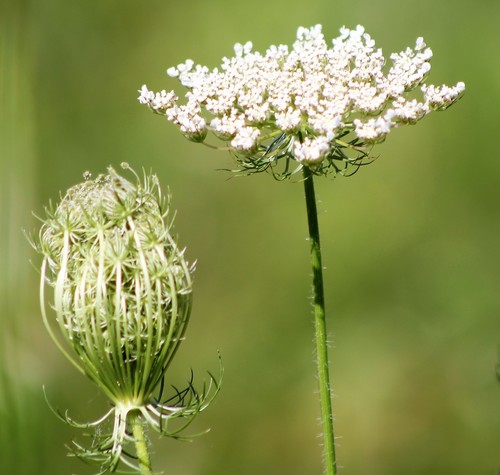
wild carrot
Daucus carota
Known affectionately as Queen Anne's Lace, the wild carrot is more than just a roadside weed; it is a complex nursery for butterflies and a masterpiece of natural geometry.
Quick Identification
Size
Height of 1-4 feet (30-120 cm); flower heads 2-4 inches (5-10 cm) wide
Colors
Creamy white flower clusters, often featuring a single tiny dark purple or red floret at the very center; bright green feathery foliage.
Key Features
- Flat-topped white lacy flower clusters (umbels)
- A single dark purple floret in the center of the bloom
- Finely divided, fern-like feathery leaves
- Flower heads curl inward into a 'bird's nest' shape as they dry
When You’ll See Them
Behavior
Wild carrot is a biennial plant, meaning it completes its life cycle over two years. In its first year, it stays low to the ground as a rosette of feathery leaves, building up energy in a sturdy white taproot. In its second year, it sends up a tall, hairy stalk to produce its iconic lace-like flowers. These blooms are highly attractive to a wide variety of beneficial insects, acting as a landing pad for pollinators who prefer flat surfaces.
One of the most charming behaviors of the wild carrot is its response to moisture and age. When the plant finishes blooming or during periods of low light and rain, the flower head contracts, curling its outer stalks inward to protect the developing seeds. This creates the 'bird's nest' appearance that makes the plant easy to identify even after it has turned brown in late summer.
EverydayEarth exclusive
Camera Tips
Capturing the wild carrot on a backyard camera offers a unique opportunity to document the 'micro-wildlife' of your garden. Because this plant is a magnet for pollinators, the best way to use your camera is to set it up in macro or close-focus mode. Position your camera on a small tripod about 12-18 inches away from a fresh bloom, angling it slightly downward to capture the full 'lace' pattern. This is the perfect setup to film the arrival of Eastern Black Swallowtail butterflies, who use this plant as a primary host for their caterpillars.
To truly showcase the plant's personality, use a time-lapse setting over a 24-hour period. You will see the flower heads physically move to track the sun and watch as they slowly fold inward as the humidity rises or the sun sets. If your camera has a high-trigger speed, place it near the blooms during the peak heat of the day (noon to 3 PM) to catch the frenetic activity of hoverflies, predatory wasps, and native bees that utilize the flat flower cluster as a refueling station.
Lighting is critical for white flowers, which can easily 'blow out' and lose detail in bright sun. If possible, position your camera so the sun is behind or to the side of the plant, rather than hitting it directly from the front. The early morning 'golden hour' provides the best contrast, highlighting the delicate hairs on the stem and the intricate webbing of the lace. In late autumn, don't move the camera; the dried 'bird's nest' seed heads make for dramatic silhouettes against the snow or frost, attracting small winter birds like goldfinches who may pick at the seeds.
Similar Species
Species that look similar or are commonly confused with wild carrot.
Frequently Asked Questions
Record wild carrot at your habitat
Connect a camera to start building your own species record — AI identifies every visitor automatically.