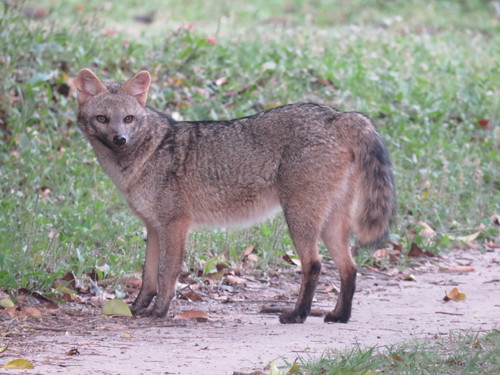
Crab-eating Fox
Cerdocyon thous
A resilient and resourceful spirit of the South American twilight, the Crab-eating Fox is a master of adaptation. From the muddy marshlands to suburban garden paths, this 'forest dog' thrives where others retreat.
Quick Identification
Size
64 cm (25 in) body length; 28 cm (11 in) tail; 5–8 kg (11–18 lbs)
Colors
Grizzled grey-brown upperparts with yellow-tinged underparts; black tips on ears and tail; dark legs
Key Features
- Bushy tail with a prominent black tip and dorsal stripe
- Robust, dog-like build with relatively short legs
- Dark mask-like shading on the muzzle
- Grizzled salt-and-pepper fur texture
When You’ll See Them
Geographic range
Where Does the Crab-eating Fox Live?
Native to the South American continent, the Crab-eating Fox occupies a massive territory that stretches from the coastal regions of Colombia and Venezuela down through the heart of Brazil to northern Argentina and Uruguay. These adaptable canids thrive in the diverse landscapes of the Cerrado and the Llanos, as well as the moist forests of the Atlantic coast. They are notably absent from the highest peaks of the Andes and the densest, most flooded parts of the Amazon basin, preferring the transitional edges where forest meets open ground.
Basemap © OpenStreetMap contributors
Behavior
The Crab-eating Fox is a socially flexible canid, typically found in monogamous pairs that share a territory, though they usually hunt and travel solo during the night. They are highly intelligent and adaptable, displaying a cautious temperament that allows them to thrive in environments ranging from deep woodlands to the fringes of busy human settlements. While they are primarily nocturnal, emerging as the sun sets to begin their foraging rounds, they are often active during the twilight hours of dawn and dusk.
In their interactions with humans, they are generally shy but can become quite bold if they grow accustomed to finding food in suburban gardens. They communicate through a series of high-pitched barks and whines, which are most frequently heard during the breeding season when pairs are coordinating their movements. Unlike many other South American canids, they are not particularly territorial against other species, focusing instead on maintaining their pair bond and raising their pups in hidden dens or hollow logs.
EverydayEarth exclusive
Camera Tips
To successfully capture the Crab-eating Fox on a backyard or trail camera, focus your efforts on 'edge' habitats. These foxes love to travel along the borders where thick vegetation meets open lawns, dirt roads, or clearings. Position your camera approximately 12 to 18 inches off the ground, angled slightly upward if the terrain is uneven. This height ensures you capture the full profile of the animal, including its diagnostic black-tipped tail and grizzled coat.
Since these foxes are primarily nocturnal and crepuscular, a camera with high-quality infrared (IR) capabilities is essential. Use 'No-Glow' or 'Black Flash' models to avoid spooking them, as they are naturally wary of artificial light sources. If you have a fruiting tree on your property, such as a palm or a guava, aim your camera at the base; the Crab-eating Fox is a dedicated fruit eater and will visit these spots nightly when the fruit is dropping. Similarly, placing a camera near a permanent water source or a muddy patch can be very effective, especially if you want to capture them foraging for the crustaceans that give them their name.
While they are opportunistic, avoid using heavy scents or baits that might attract domestic dogs, which could drive the foxes away. Instead, look for natural funnels like gaps in fences or established game trails through tall grass. If you are in a suburban area, these foxes often follow the same predictable patrol route every night. Once you find a 'hot' spot on your camera, keep it there—the foxes are creatures of habit and will likely return to the same frame several times a week. Set your camera to take 3-photo bursts or short 10-second videos to catch their characteristic trotting movement.
Similar Species
Species that look similar or are commonly confused with Crab-eating Fox.
Frequently Asked Questions
Record Crab-eating Fox at your habitat
Connect a camera to start building your own species record — AI identifies every visitor automatically.