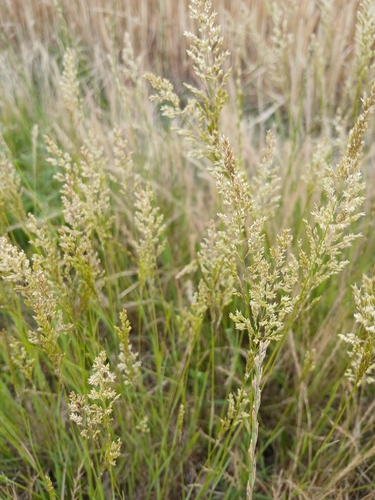
Creeping Bent
Agrostis stolonifera
A resilient traveler from Eurasia, Creeping Bent is the master of the 'low-profile' lifestyle, creating lush, velvet carpets in damp meadows and suburban yards alike. Known for its remarkable ability to spread via surface runners, it is the unsung architect of the world's most famous golf greens.
Quick Identification
Size
Height ranges from 10–40 cm (4–16 inches), with horizontal stolons (runners) that can spread several meters.
Colors
Typically a vibrant blue-green to grayish-green; flower panicles often show a distinct purple or reddish tint.
Key Features
- Prostrate horizontal stolons that root at the nodes
- Long, membranous ligule (2–6 mm) with a rounded tip
- Narrow leaf blades with fine, prominent ribs on the upper surface
- Dense, narrow flower panicles that open slightly during mid-summer
When You’ll See Them
Geographic range
Where Does the Creeping Bent Live?
Originally native to the temperate regions of Eurasia and North Africa, Creeping Bent has become one of the most widely distributed grasses in the world. It is now common throughout North America, from the subarctic reaches of Canada to the southern United States, and has established significant populations in Australia, New Zealand, and parts of South America. It thrives in cool-temperate climates where moisture is consistent, often escaping from cultivated golf courses to naturalize in nearby wetlands and damp pastures.
Basemap © OpenStreetMap contributors
Behavior
In suburban landscapes, it is often viewed as a persistent weed in residential lawns but is highly valued on golf course putting greens for its ability to tolerate extremely low mowing heights. It is a resilient species that can withstand significant foot traffic, regenerating quickly from its network of surface runners even after physical damage or heavy grazing by local wildlife.
EverydayEarth exclusive
Camera Tips
Timing and lighting are critical for botanical photography. Set your camera to capture high-resolution stills or 4K video during the early morning hours. The morning dew often clings to the fine ribs of the Creeping Bent leaves, making them stand out against the background. The 'golden hour' light also highlights the reddish-purple hues of the flower panicles, which are often too delicate to see in the harsh midday sun.
For a unique perspective, use a time-lapse setting over a 48-hour period. While plants may seem stationary, a time-lapse will reveal how Creeping Bent leaves move in response to hydration and sunlight, and how the stolons slowly 'creep' across the soil surface. This is particularly effective in the spring when growth is most rapid. Ensure your camera is set to a close-focus or macro mode if available, as the distinguishing features like the ligule and the fine leaf ribs are very small.
If you are using the camera to monitor the health of your backyard habitat, place it near a transition zone where the grass meets a garden bed or a water feature. Creeping Bent loves moisture, and these 'edge' zones are where you will see the most dramatic growth and interaction with local insects like grasshoppers and meadow nymphs that use the dense mat for cover.
Similar Species
Species that look similar or are commonly confused with Creeping Bent.
Frequently Asked Questions
Record Creeping Bent at your habitat
Connect a camera to start building your own species record — AI identifies every visitor automatically.