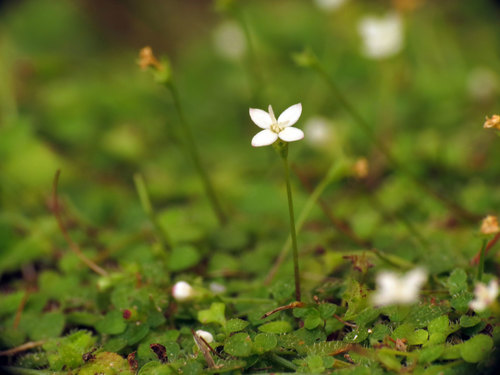
creeping bluet
Oldenlandiopsis callitrichoides
Discover the 'hidden carpet' of your garden with the creeping bluet, a tiny, mat-forming wonder that transforms damp corners into lush green tapestries. This resilient tropical native proves that even the smallest plants can play a big role in your backyard ecosystem.
Quick Identification
Size
Prostrate stems 5–15 cm (2–6 in) long; leaves tiny at 2–5 mm (0.08–0.2 in)
Colors
Bright emerald green foliage with microscopic white to pale lavender flowers
Key Features
- Prostrate, mat-forming growth habit that roots at the nodes
- Tiny, opposite ovate leaves with minutely hairy margins
- Square-shaped delicate stems
- Solitary, four-petaled flowers appearing in leaf axils
When You’ll See Them
Geographic range
Where Does the creeping bluet Live?
Creeping bluet is native to the tropical landscapes of the West Indies, southern Mexico, and Central America. Its adaptable nature has allowed it to naturalize extensively across the globe, with established populations now found in the humid regions of Florida and Hawaii in the United States. Beyond North America, this resilient groundcover has spread through parts of South America and tropical Africa, often following human development into urban and suburban environments.
Basemap © OpenStreetMap contributors
Behavior
Creeping bluet is a delicate, low-growing perennial that forms dense, moss-like mats in damp, shaded environments. Unlike many garden plants that compete for height, this species thrives by hugging the ground, often colonizing the gaps between paving stones or the shaded margins of flower beds. It spreads primarily through its rooting stems, which allow it to quickly cover bare soil and create a lush green carpet.
While often overlooked due to its diminutive size, creeping bluet is quite resilient. It responds quickly to moisture, appearing vibrant and turgid after rainfall and becoming more inconspicuous during dry spells. In a backyard setting, it often acts as a 'stealth' groundcover, coexisting with lawn grasses or ornamental plants without being overly aggressive, though its ability to root at nodes makes it a persistent presence once established.
EverydayEarth exclusive
Camera Tips
Capturing the creeping bluet on camera requires a specialized approach because of its tiny stature. Standard trail cameras are usually designed for larger animals and may have a minimum focus distance of 3 to 5 feet, which will result in a blurry green smudge for this species. To get a clear shot of this plant's delicate white flowers, you will need to use a camera with macro capabilities or mount your device extremely low to the ground—ideally just a few inches above the soil—using a ground spike or a flat base.
Because creeping bluet is so small, AI-powered cameras may not trigger based on movement unless an insect like a small pollinator visits the flower. Instead of relying on motion sensors, set your camera to time-lapse mode during the morning hours. This is when the tiny blossoms are most likely to be open and vibrant. Positioning the camera to face north or south will help prevent lens flare from the sun while providing enough ambient light to highlight the fine texture of the leaves and the square shape of the stems.
For the best results, focus on areas of your yard that stay consistently damp, such as near a leaky outdoor faucet, the shaded side of a stone walkway, or beneath a condensation-heavy AC unit. Since these plants are sensitive to moisture, a shot taken shortly after a light rain or early morning dew will show the foliage at its most turgid and green. If you are using an AI camera to track backyard biodiversity, manual tagging might be necessary initially to train the system to recognize this specific groundcover in its environment.
Seasonal timing is also key. While the plant is green year-round in many areas, flowering peaks after periods of heavy rain followed by bright, indirect sunlight. If you want to capture the lifecycle of the creeping bluet, look for the minute seed capsules that form after the flowers fade. These are often easier to see in high-resolution macro shots than with the naked eye.
Similar Species
Species that look similar or are commonly confused with creeping bluet.
Frequently Asked Questions
Record creeping bluet at your habitat
Connect a camera to start building your own species record — AI identifies every visitor automatically.