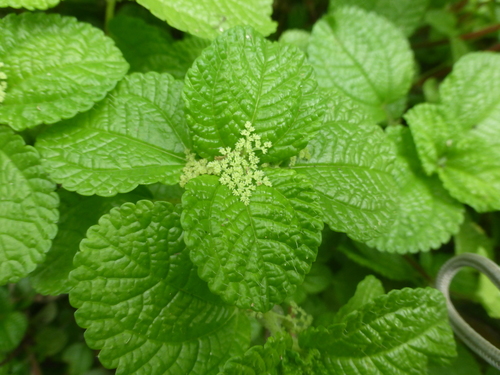
Creeping Charlie
Pilea nummulariifolia
A lush, quilted groundcover that transforms garden floors and hanging baskets into vibrant green carpets. Known for its crinkled leaves and rapid trailing growth, this tropical Pilea is a master of the shaded understory.
Quick Identification
Size
Trailing stems reach 30-90 cm (12-36 in) in length; individual leaves are 2-5 cm (0.75-2 in) in diameter.
Colors
Lush lime to deep forest green leaves; stems are often a contrasting reddish-brown or bronze.
Key Features
- Deeply puckered or 'quilted' leaf texture
- Oval-shaped leaves with scalloped, crenate margins
- Creeping or trailing growth habit that forms dense mats
When You’ll See Them
Geographic range
Where Does the Creeping Charlie Live?
The Creeping Charlie, specifically Pilea nummulariifolia, is a native treasure of the Caribbean islands and the northern reaches of South America, where it blankets the forest floors in damp, tropical environments. From the lush landscapes of Puerto Rico and Jamaica to the humid rainforests of Venezuela and Colombia, this plant thrives in the warm understory where sunlight is filtered and moisture is plentiful. While it remains a tropical resident at heart, it has been widely introduced to many subtropical regions across the globe, including parts of the southern United States and Southeast Asia, where it is often found in managed gardens or escaping into shaded, moist corridors near human habitations.
Basemap © OpenStreetMap contributors
Behavior
Creeping Charlie is a vigorous, low-growing perennial known for its ability to quickly colonize shaded ground. In its native tropical habitat, it functions as an efficient groundcover, using its adventitious roots to 'walk' across the forest floor. The plant spreads horizontally, sending out long runners that root at every node when they come into contact with moist soil, creating a thick, pillowy carpet that protects the soil from erosion.
While it is a passive organism, it exhibits clear environmental responses. It is highly phototropic, meaning its stems and leaves will visibly shift over time to maximize their surface area in filtered light. It also reacts to humidity levels; in dry conditions, the quilted leaves may lose some of their turgidity, only to bounce back quickly after a rain or misting. In suburban environments, it is often seen cascading from hanging baskets or filling in the gaps between pavers in shaded garden corners.
EverydayEarth exclusive
Camera Tips
Capturing the subtle growth of Creeping Charlie requires a different approach than filming mobile wildlife. To get the best results with your AI camera, focus on a macro perspective. Positioning your camera just 6 to 12 inches from a dense patch of foliage will allow you to capture the stunning 'quilted' texture of the leaves, which can look like a rolling green landscape on screen. If you are using a trail camera, ensure it has a high-resolution sensor and a close-focusing lens to prevent the image from blurring at short distances.
Lighting is the most critical factor for documenting this species. Creeping Charlie thrives in the dappled light of the forest floor, and your camera will too. Avoid harsh, direct midday sun, which can overexpose the leaves and hide their unique topography. The best footage is usually captured during the early morning or late afternoon when low-angle light casts shadows into the valleys of the crinkled leaves, giving the plant a three-dimensional, pillowy appearance. If your camera allows for manual exposure settings, underexposing slightly can help preserve the rich, saturated greens.
One of the most rewarding ways to use your backyard camera with Creeping Charlie is through time-lapse photography. While plants don't 'run,' they are remarkably active. Over a 24-hour period, you can observe the stems slowly orienting themselves toward the light and the leaves slightly drooping or lifting in response to moisture levels. Set your camera to take a photo every 15 to 30 minutes to create a compelling visual of the plant 'breathing' and expanding its reach across the soil.
Don't forget that a healthy patch of Creeping Charlie is an ecosystem of its own. By pointing your camera at the leaf canopy, you can often capture secondary wildlife. Small spiders, predatory mites, and various pollinators are frequently attracted to the microclimate created by the dense, moist leaves. Set your motion trigger sensitivity to its highest level to catch these tiny movements, or use a hybrid mode that records both still images and short video clips when any activity is detected within the greenery.
Similar Species
Species that look similar or are commonly confused with Creeping Charlie.
Frequently Asked Questions
Record Creeping Charlie at your habitat
Connect a camera to start building your own species record — AI identifies every visitor automatically.