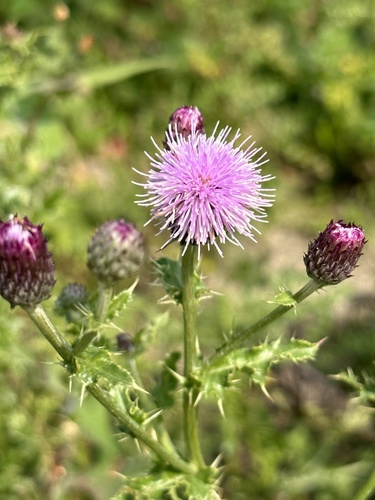
creeping thistle
Cirsium arvense
A resilient perennial famous for its vibrant purple blooms and prickly leaves, the creeping thistle is a powerhouse of backyard biodiversity. While gardeners may struggle with its spreading roots, it remains one of the most important nectar sources for butterflies and bees.
Quick Identification
Size
30 to 150 cm (1 to 5 feet) tall; flower heads 1–2.2 cm (0.4–0.9 inches) in diameter
Colors
Purple, lavender, or occasionally white flower heads; dull grey-green foliage
Key Features
- Clusters of small, urn-shaped flower heads
- Leaves with deeply lobed, spine-tipped edges
- Smooth, non-winged stems between leaf nodes
- Horizontal creeping root system that forms dense colonies
When You’ll See Them
Geographic range
Where Does the creeping thistle Live?
The creeping thistle is native to the temperate regions of Europe, Western Asia, and Northern Africa, where it has thrived for millennia. Since the colonial era, it has successfully established itself across North America, from the subarctic reaches of Canada to the southern United States, as well as parts of South America and Oceania. It is most commonly found in high-density populations within the mid-latitudes of the Northern Hemisphere, particularly in agricultural and suburban landscapes.
Basemap © OpenStreetMap contributors
Behavior
Creeping thistle is a hardy perennial known primarily for its aggressive growth and colonial nature. Unlike many other thistles that grow as individuals, this species spreads through an extensive underground network of rhizomes. These roots can reach depths of several meters and spread horizontally, allowing a single plant to quickly dominate a backyard garden or meadow by sending up dozens of genetically identical clones. While many gardeners view it as a stubborn weed, it plays a vital role in the ecosystem as a high-value nectar producer.
The plant exhibits a 'dioecious' tendency, meaning individual plants often produce either male or female flowers, requiring insects to facilitate cross-pollination. During the late summer, the fertilized female flowers produce thistle-down—fluffy white hairs attached to seeds—which use the wind to travel long distances. Despite its prickly exterior, the creeping thistle is relatively social in the plant world, often forming the centerpiece of a bustling micro-ecosystem where various insects congregate for food and shelter.
EverydayEarth exclusive
Camera Tips
To capture the best footage of a creeping thistle, focus your camera not just on the plant itself, but on the high-traffic 'pollinator highway' it creates. Position your camera on a tripod or stable mount roughly 2 to 3 feet from the flower heads. Because this species is shorter than some other thistles, a lower angle looking slightly upward can create a dramatic silhouette against the sky, highlighting the intricate spines and delicate purple florets.
Use a 'Macro' or close-focus setting if your AI camera supports it. Since plants don't move (unless it's windy), the real action comes from the visitors. Set your trigger sensitivity to high to capture the rapid movement of bees, hoverflies, and Painted Lady butterflies that frequent the nectar-rich blooms. To avoid 'false triggers' caused by the plant swaying in the breeze, try to shield the plant from heavy wind or use a faster shutter speed if manual controls are available.
For a unique project, use a time-lapse mode during the peak summer months. Setting your camera to take a photo every 15 minutes over a week can reveal the fascinating process of the flower heads opening and eventually transforming into the iconic white thistle-down. Early morning light (the 'Golden Hour') is particularly effective for illuminating the fine hairs on the leaves and stems, giving the plant a luminous, ethereal quality in your photos.
Similar Species
Species that look similar or are commonly confused with creeping thistle.
Frequently Asked Questions
Record creeping thistle at your habitat
Connect a camera to start building your own species record — AI identifies every visitor automatically.