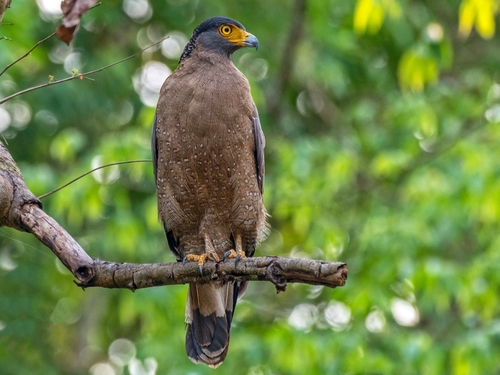
Crested Serpent-Eagle
Spilornis cheela
A striking specialist of the Asian tropics, the Crested Serpent-Eagle is famous for its crown of feathers and its fearless appetite for snakes. Often seen soaring high or keeping watch from forest edges, this majestic raptor is a true icon of the jungle canopy.
Quick Identification
Size
Length 51-71 cm (20-28 in); Wingspan 110-145 cm (43-57 in); Weight 450-1800 g (1-4 lbs)
Colors
Dark sooty-brown upperparts; underparts are paler brown with fine white ocelli (spots); striking yellow facial skin and cere; black and white banded crest.
Key Features
- Large bushy crest on the back of the head
- Prominent yellow bare skin between eye and beak
- Wide white band across the tail and wings visible in flight
- Stocky build with powerful, unfeathered yellow legs
When You’ll See Them
Geographic range
Where Does the Crested Serpent-Eagle Live?
The Crested Serpent-Eagle is a hallmark species of tropical Asia, with a vast range that begins in the Indian subcontinent and extends eastward through Southeast Asia. It is a common sight in the forests of India, Sri Lanka, and Southern China, reaching down through the Indochinese Peninsula and across the Indonesian archipelago to the Philippines. Because it is a resident species that does not migrate, it has evolved into numerous island-specific subspecies throughout the Malay Archipelago.
Basemap © OpenStreetMap contributors
Behavior
The Crested Serpent-Eagle is a master of the sit-and-wait hunting technique. It spends much of its morning perching prominently on high branches overlooking forest clearings or roadsides, scanning the ground for movement. Unlike some raptors that hunt on the wing, this species prefers to swoop down from a stationary position once it identifies prey. It is a highly vocal bird, often heard before it is seen, emitting a loud, ringing three-note whistle while soaring high over the canopy on thermals.
While generally solitary or seen in pairs, these eagles are strictly territorial. They are well-known for their specialized ability to handle snakes, using their thick, scaly legs as protection against bites. In areas near human settlements, they are relatively tolerant of people as long as they have access to tall trees for nesting and hunting, though they will fiercely defend their nests during the breeding season.
EverydayEarth exclusive
Camera Tips
Capturing a Crested Serpent-Eagle on a backyard or trail camera requires focusing on their 'sentinel' behavior. These birds have favorite perching spots—usually a sturdy, horizontal branch with a clear view of the ground below. If you have tall trees on your property that overlook a lawn, garden, or forest edge, mount your camera at a height of 10 to 15 feet aiming toward these branches. A steep upward angle can work if the bird is perching, but for the best action shots, aim the camera across a clearing where they might swoop down to catch prey.
While you cannot easily bait these eagles with traditional birdseed, you can attract them indirectly by creating a habitat that supports their prey. A rock pile, a small pond, or a patch of high grass will attract the lizards, frogs, and snakes that form the bulk of their diet. If a Serpent-Eagle identifies your yard as a reliable hunting ground, it will return to the same perches daily, allowing you to fine-tune your camera placement over time.
Timing is critical for these raptors. They are most active once the sun has warmed the air, typically from mid-morning through the afternoon. Set your camera's PIR sensor to high sensitivity to ensure it triggers on the bird's movement, and use a fast shutter speed (at least 1/1000s) if your camera allows, as their descent from a perch is incredibly rapid. During the rainy season, look for them perching in more open areas to dry their feathers after a storm, which provides excellent lighting and stationary subjects for high-quality captures.
Similar Species
Species that look similar or are commonly confused with Crested Serpent-Eagle.
Frequently Asked Questions
Record Crested Serpent-Eagle at your habitat
Connect a camera to start building your own species record — AI identifies every visitor automatically.